
Why Krillion Rejects Answers That Look Right: Validation, Normalization & the Six Rarity Tiers
Fast answer: Krillion rejects your answer because it validates by exact match against a closed, pre-built answer catalog — not by judging whether your answer is actually correct. Every prompt ships with a human-reviewed list of canonical answers and registered aliases, each already carrying a fixed rarity tier. If your normalized text isn't on that list, you get a clean rejection, even when your answer is genuinely right. Here's how that pipeline works, the seven ways a valid-looking answer falls out of it, and what you can do about each one.
- ✓ How Krillion's closed-catalog validation and normalization pipeline actually work
- ✓ The seven reasons a correct-looking answer gets rejected — with a first-hand capture
- ✓ How the six fixed rarity tiers are scored, and why they don't move mid-game
- ✓ Why catalog size decides how likely an honest omission is
- ✓ A copy-paste triage checklist for your next rejection, and how to report real omissions
- ✓ What the sources can't tell us — the honest limits
In a hurry? Check whether your word counted on past prompts →
Why Krillion rejects answers: the closed-catalog rule
Most daily word games check your input against a dictionary or a live language model. Krillion does neither. According to the official FAQ ↗, answer sets are curated in advance "by aggregating datasets (dictionaries, wiki pages, encyclopedias, whatever sources the question calls for), then merging and cleaning the result into one answer set." Rarity tiers are attached during that same editorial pass — some prompts scored mechanically against a familiarity database, others with LLM assistance and a manual review. When you play, the game isn't thinking about your answer at all; it's looking it up.
Two consequences follow. First, catalogs are prompt-scoped: the method page ↗ states plainly that "the same word can be accepted under one question and rejected under another." Second, every judgment call — which spellings count, whether a stretch answer is clever or just wrong — was made by the editor before the dive went live, and frozen into a versioned catalog. If your idea isn't in that version, no amount of correctness rescues it mid-game. You can see exactly what made each past catalog in our answer archive, and check whether a specific word counted on any logged prompt with the answer checker.
How Krillion validates what you type, step by step
The method page documents a textbook normalization pipeline, and each step maps to a rejection you've probably hit:
- Structural rejections. Empty submissions, anything over 80 characters, and punctuation-only text are thrown out before matching begins.
- Unicode NFKC normalization. Compatibility variants — fullwidth characters, ligatures, superscripts — fold onto their plain equivalents, the standard trick for loose matching described in Unicode UAX #15 ↗.
- Lowercasing. Case never decides acceptance.
- Punctuation becomes spacing. Hyphens and apostrophes turn into word separators rather than vanishing, so "spider-man"-style names stay token-separated instead of gluing into one word.
- Whitespace collapse, then exact match. The method page's worked example shows "Storm," "storm!" and a version padded with extra spaces all reducing to the same lookup key.
The decisive line is what the pipeline omits: "no fuzzy matching, no thesaurus, no translation, and no runtime language models." A near-miss typo or an unregistered synonym fails cleanly. That's deliberate — it keeps validation deterministic and auditable — but it means the burden of matching the catalog's exact form sits entirely on you.
Seven reasons a valid-looking answer gets rejected
After logging every daily sheet since launch and comparing them against the documented pipeline, every rejection I've seen decomposes into one of these:
- Catalog omission. The answer is valid but the editor never found it. The developer's own one-line FAQ answer to "why was my answer not listed?" is disarmingly honest: "Because I didn't find it, sorry. Sometimes I miss a source."
- Unregistered spelling variant. With no spell-correction at runtime, a genuinely different spelling is rejected rather than treated as a rare answer. Diacritics only pass where both forms were registered — a German-dish prompt on August 19 accepted both Käsespätzle and Spaetzle because someone listed both by hand.
- Plural vs. singular. Normalization doesn't stem or lemmatize, so each word form needs its own catalog entry. Archived sheets show both forms listed only where the editor chose to accept both.
- Multi-word phrasing. Punctuation folds to spacing, but word order and completeness must still match the canonical form or an alias. Half a name is a different string, not a partial credit.
- Proper-noun conventions. First name vs. surname vs. full name is an editorial decision encoded per answer — type the wrong granularity and you're out.
- Prompt-scope mismatch. Country vs. territory, actor vs. character, sport vs. competition — your word can be real, spelled perfectly, and still answer a slightly different question than the one asked.
- The unanticipated loophole. A prompt-bending stretch the editor saw coming lands in the catalog at the punitive 15-point Too Clever tier; one they didn't is simply rejected. There is no published rule for which loopholes pass, which is why chasing them is a lottery.
Reason #6 is the one we can show you first-hand. Playing today's dive on krillion.io while writing this (September 14, 2026), prompt 1 asked us to "name a modern country that Alexander the Great's empire reached." We typed Persia — historically a perfect fit, since Alexander's empire swallowed it whole — and the game rejected it on the spot: red error state, score frozen at 0, depth still 0 meters. Persia answers the history but not the adjective; it isn't a modern country, so it isn't in this prompt's catalog no matter how correct it feels.
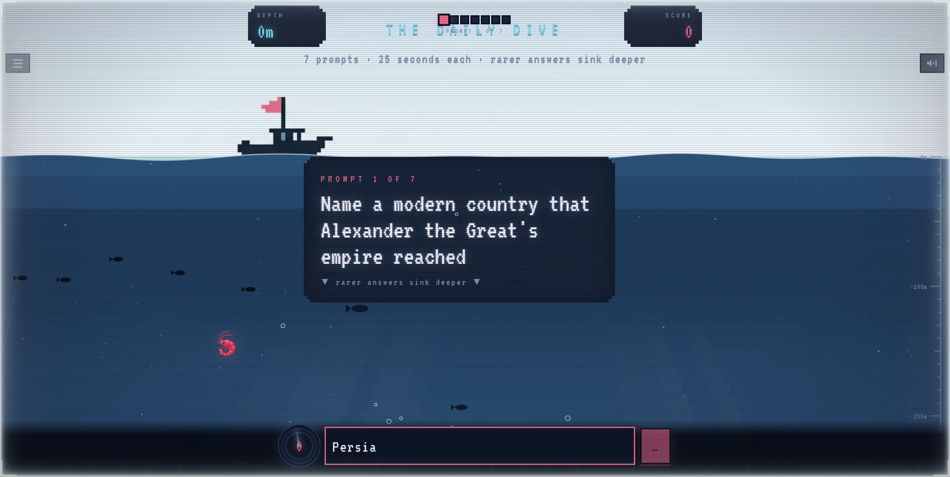
One mercy worth knowing: rejection is silent and sterile. The method page says an unknown but well-formed guess "returns a normal rejection without saving the raw text, changing statistics, or advancing the answer screen" — failed guesses don't leak into the data used for future calibration, and they don't cost you anything but time. Our Persia miss behaved exactly like that: no penalty, no record, just a red flash and the clock still running.
How Krillion scoring works: six fixed rarity tiers
The biggest misconception I see — and one most community guides get wrong — is that Krillion recomputes rarity from each day's submissions. It doesn't. Per the method page, "the active catalog version fixes that mapping before players begin," and "the first accepted player receives the same fixed result as later players." Player aggregates are collected (one counted contribution per participant per prompt, stored as privacy-safe hashes), but they only ever inform future, human-reviewed catalog revisions — never a mid-game rewrite.
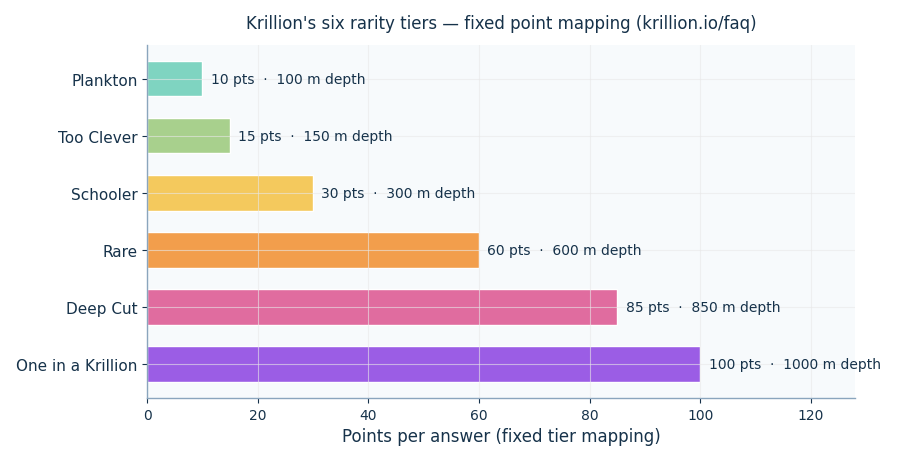
So the ladder — Plankton 10, Too Clever 15, Schooler 30, Rare 60, Deep Cut 85, One in a Krillion 100, with each point worth 10 meters of depth toward a 700-point, 7,000-meter perfect dive — is editorial, not statistical. The full score table is on our rarity reference page, and the arithmetic behind the daily total is in the scoring-math breakdown. One quirk straight from the FAQ: the 100-point gem isn't chosen on rarity alone — past a certain depth rarity gets hard to disambiguate, so it's also picked "for fun factor." Our own logs bear that out: the gem is occasionally less obscure than some Deep Cuts on the same sheet.
| Tier | Points | Depth | What the editor means by it |
|---|---|---|---|
| Plankton | 10 | 100 m | The answer nearly everyone gives first |
| Too Clever | 15 | 150 m | The go-to "obscure" pick that isn't, or a prompt-bending stretch |
| Schooler | 30 | 300 m | Known without being automatic |
| Rare | 60 | 600 m | An answer few players think to type |
| Deep Cut | 85 | 850 m | For people who know the subject |
| One in a Krillion | 100 | 1,000 m | One designated gem per prompt, picked partly "for fun factor" |
Bottom line: the points and depth in this table are the published, fixed mapping — your tier never depends on when you play or how many people played before you. What you control is only which rung your answer was filed under, so the skill is steering toward answers an editor would file deep. Tier meanings per the official FAQ ↗.
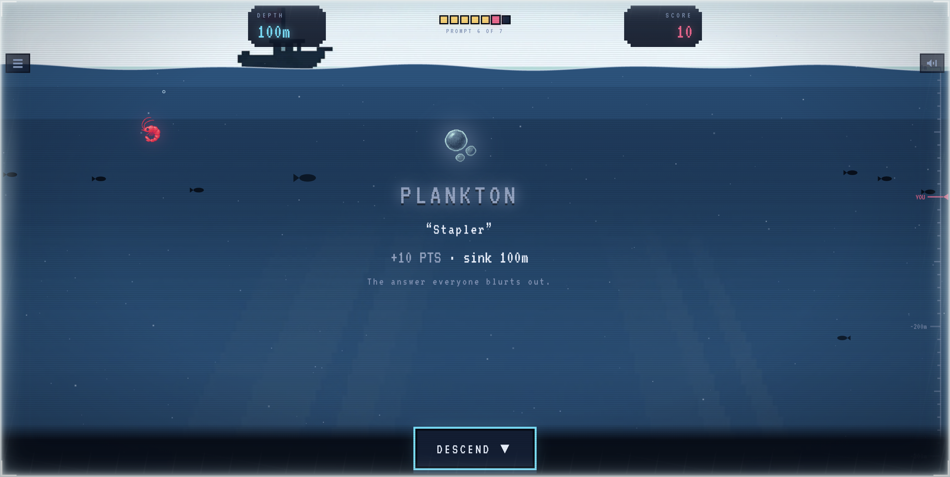
This is what a fixed tier looks like at reveal time. Later in the same September 14 dive we answered a prompt with Stapler, and the game flipped to its verdict card: PLANKTON — "Stapler" — +10 PTS · sink 100m, with the gentle dig "the answer everyone blurts out." The tier, the points and the depth were all decided before we typed a letter; the reveal just reads them back.
Playing today's dive and want to sanity-check an idea before you burn it? Look the word up in the answer checker to see which tier it earned on past prompts, or compare against today's full answer sheet after your dive closes.
Why some prompts reject far more answers than others
Catalog size varies by more than two orders of magnitude with category breadth, and it directly sets your odds of an accidental omission. A constrained prompt like "name a country starting with M" ships with 19 accepted answers; a broad pop-culture prompt runs into the thousands. September 7's "name a Mario character" holds 3,147 — the biggest roster we've logged — while a broad mammals prompt carried 2,502, almost all of them Deep Cuts.
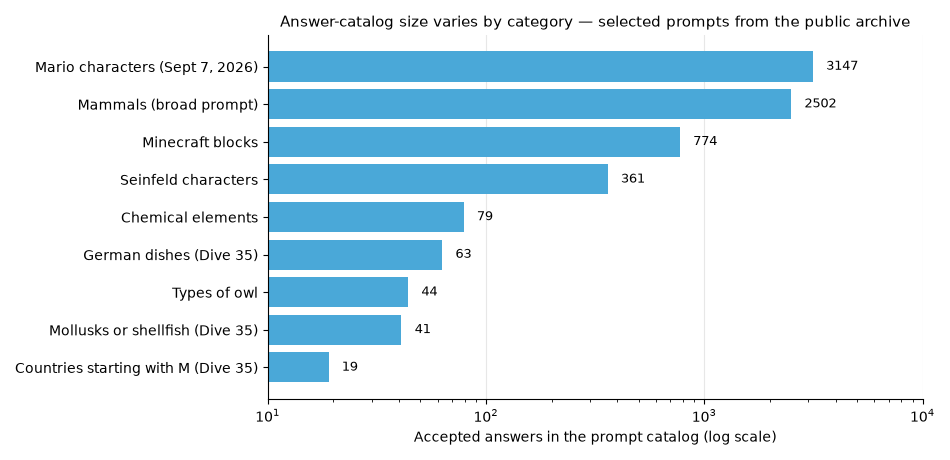
The practical reading: on a 19-answer factual prompt, the catalog is probably complete and a rejection almost always means a scope or spelling problem. On a 3,000-answer pop-culture prompt, the long tail was assembled from wikis and fan lists, and honest omissions are far more likely — which is exactly the case the report-for-review channel exists for.
What to do when Krillion rejects a correct answer
- Re-read the prompt's exact scope. Most avoidable rejections are category traps — territory for country, character for actor. Fix the scope before the spelling.
- Respell canonically. Use the most standard reference-work spelling; drop or keep diacritics to match how an encyclopedia lists the entry.
- Try the other number or form. Singular vs. plural, full name vs. surname — each is a separate catalog key.
- Check the precedent. The answer checker shows whether your word (or its variants) counted on any logged prompt, which tells you whether you're fighting an omission or a convention.
- Report real omissions. The method page is explicit that a plausible omission should be reported for human review rather than silently guessed at runtime — fixes ship as reviewed, versioned catalog updates with the same alias-conflict checks as the original release.
Same routine, as a checklist you can copy into your notes and run in the 25 seconds the official homepage currently gives each prompt:
KRILLION REJECTION TRIAGE — run before you blame the game
[ ] Scope: does my answer fit every word of the prompt
    (modern / country / character, not just the topic)?
[ ] Spelling: is this the standard reference-work spelling?
[ ] Form: would singular/plural or full name/surname match better?
[ ] Length: under 80 characters, not punctuation-only?
[ ] Precedent: has this word (or a variant) counted on a past
    prompt? → answer checker
[ ] All five pass and it's still rejected → likely a catalog
    omission: report it for human review, then let it go.
Honest limits: what we know and what we don't
A few sourcing caveats, because precision matters on this topic. The detailed validation documentation (normalization, exact matching, counted-once aggregation) is published on a Krillion-affiliated domain, krillion.live, rather than the main krillion.io FAQ — it is internally consistent with the FAQ and with the behavior we observe daily, but read it as the developer's description of intent, not an audited specification. The player-share percentages attached to tiers elsewhere online (">35% of players land Plankton," and so on) come from a third-party fan guide and are estimates, not official figures — Krillion does not publish per-answer player counts. The distribution data and examples here come from fan-maintained archives, including the daily sheets we log ourselves. And the obvious one: this site is an unofficial companion with no affiliation to the game's developer — when the game and this article ever disagree, the game is right.
Before your next dive: run your riskiest idea through the answer checker → — it shows the exact tier that word earned on every logged prompt, so you can tell a catalog omission from a convention before it costs you a prompt.
Free fallback: drill the triage checklist in practice mode → — unlimited rounds built from real past sheets, no daily limit, no stakes — or peek at today's spoiler-free hints if you just want each tier's answer count before you commit.
Frequently asked questions
Why was my Krillion answer rejected even though it was correct?
Because Krillion does not judge correctness at runtime — it checks whether your normalized text exactly matches a canonical answer or registered alias in a pre-built, human-reviewed catalog for that specific prompt. A genuinely correct answer that the editor never found, or a spelling variant nobody registered as an alias, is rejected all the same.
What counts as a valid answer in Krillion?
A valid answer is any string that, after normalization, exactly equals a canonical answer or a registered alias in the active catalog for the exact prompt you are answering. Validity is prompt-scoped: the game's own method page notes that the same word can be accepted under one question and rejected under another.
Does Krillion accept misspellings or typos?
No. The published method rules out fuzzy matching, spell-correction, a thesaurus and translation at runtime, so a near-miss typo fails cleanly rather than being rescued. Spelling variants only work when an editor has registered them as aliases — which is why both Käsespätzle and Spaetzle counted on a German-dish prompt: both were listed by hand.
Does Krillion accept both plural and singular forms?
Only if each form exists in the catalog. Normalization lowercases text and folds punctuation, but it does not stem or lemmatize, so plural and singular are different lookup keys. Archived sheets show both forms listed side by side only where the editor chose to register each one.
How does Krillion scoring work?
Every accepted answer carries one of six fixed rarity tiers — Plankton 10, Too Clever 15, Schooler 30, Rare 60, Deep Cut 85 and One in a Krillion 100 points — and each point converts to 10 meters of dive depth, so seven prompts top out at 700 points and 7,000 meters. Tiers are assigned by the editor before anyone plays, not computed live from that day's submissions.
Is a Too Clever answer a rejection in Krillion?
No — Too Clever is an acceptance tier worth 15 points, one rung above Plankton, for technically valid answers that bend the prompt or that every seasoned player reaches for. The rejection case is the loophole the editor did not anticipate: an unlisted stretch simply fails, and there is no published rule for which loopholes pass.
Are Krillion rarity tiers based on how many players picked an answer?
Not live. According to the game's method page, the active catalog version fixes every tier before players begin, so the first accepted player gets the same result as the last; player aggregates only inform later, human-reviewed catalog revisions. The player-share percentages you see attached to tiers online are fan-guide estimates, not official figures.
Can I report a correct answer that Krillion missed?
Yes, and that is the intended path: the method page says a plausible omission stays rejected in the current catalog version and should be reported for human review rather than silently guessed at runtime. Fixes ship as reviewed, versioned catalog updates — the developer's own FAQ answer to missing answers is simply: 'Because I didn't find it, sorry. Sometimes I miss a source.'
Why does Krillion accept my word on one prompt but reject it on another?
Because catalogs are built per prompt, not globally. Your word may sit in one prompt's catalog with a tier and simply not exist in another's — the method page's own example is a word like 'storm' passing a weather-style prompt but failing elsewhere. Category-scope traps like country vs. territory or actor vs. character decide acceptance more often than spelling does.