
Keep your first qualifying idea as a fallback. Consider a replacement only when you can explain why it fits and still have time to type it. A second thought does not automatically earn more points.
When is switching worth considering?
| Check | Keep your fallback | Consider switching |
|---|---|---|
| Prompt fit | The replacement misses a condition or you are unsure. | You can verify every condition. |
| Input | You would need to guess the spelling. | You can enter the complete name confidently. |
| Time | There is little time to edit and submit. | You still have room for the whole input. |
Use this checklist at your own pace. Leave enough time to type the complete answer and recover from an input error.
Pakistan and Comoros: a recorded difference of 75 points
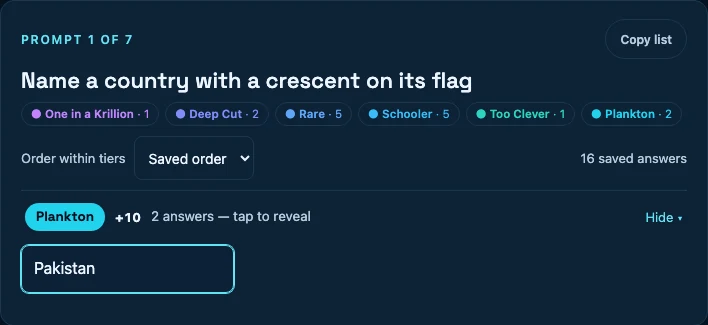
The first question is fit: does the flag contain a crescent? The second is grade: what does this dated sheet record? Keep those checks separate.
The August 24, 2026 question asked for a country with a crescent on its flag. The saved sheet records:
- Pakistan and Turkey: Plankton, 10 points each.
- Comoros: Deep Cut, 85 points.
- Difference: 85 − 10 = 75 points, or 750 metres.
If you already know the Comoros flag, it is a candidate you can check against the wording. The sheet does not show which word a player thought of first, how long they hesitated, or whether switching caused a better result.
Try one alternate route through the category
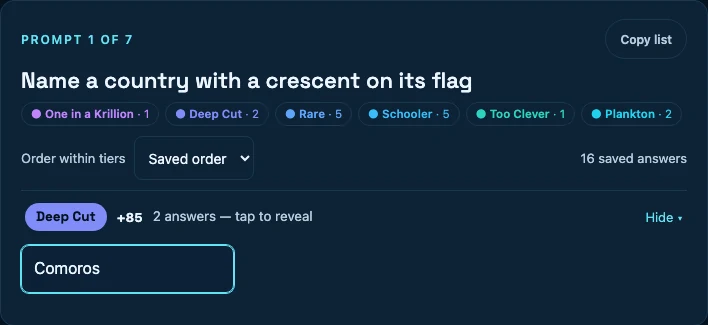
Comoros is useful only if you can recall its flag and enter the name. This comparison supports a specific alternative, not the rule “always abandon your first answer.”
- Name a fallback that fits the complete question.
- Try one different region, era or subcategory.
- Check the alternative’s fit and spelling.
- Choose once, then leave time to enter it.
Do not replace a familiar answer merely because it feels obvious. A qualifying answer you can submit is worth considering when the alternative is only a vague association.
Review the decision without inventing a rule
In untimed practice, write both candidates down before submitting one. Then expand the saved answers and look for both words. Practice covers a limited set of recent past dives; an older example may be available only in the Archive.
- If both words appear, compare their recorded tiers for that question.
- If one is missing, record “not found here”; do not assign it zero as an official verdict.
- If you missed a qualifier, change the checking step rather than just memorizing the higher-scoring word.
Frequently asked questions
Is the first answer usually worth 10 points?
We do not have first-thought or player-submission data. Check its recorded grade for the exact question instead of assuming a tier.