
A gem is a recorded 100-point answer for a particular question. Check a candidate’s facts, wording and spelling, then compare its recorded tier after playing.
Check four things before chasing a gem
- Type: a character, person, title, country or something else?
- Conditions: every date, medium, letter and geographic restriction.
- Name: a complete spelling you can enter.
- Evidence: after playing, the dated sheet’s actual tier.
The official FAQ says the top pick also considers enjoyment. It need not be the least familiar entry. Choose a connection you can explain and a name you can enter.
A character: Lewis Dodgson
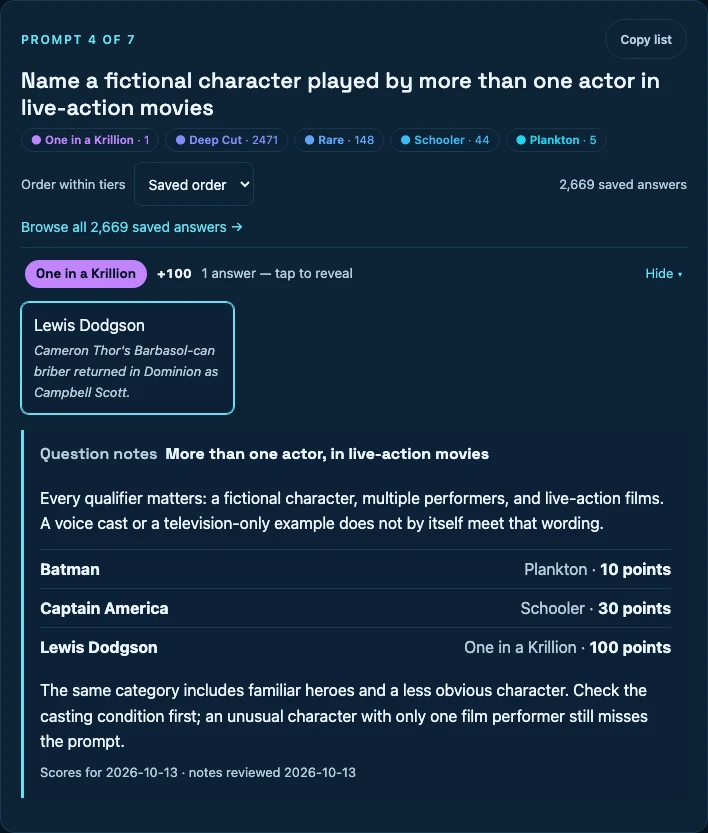
Read “character” before recalling an actor. The useful connection is Dodgson’s credited portrayals in two live-action films; a voice-only recasting would not establish that fit.
The October 13 multi-actor live-action character question records Lewis Dodgson at 100, and James Bond at 10. The useful clue is the character’s two credited portrayals. Use the character’s name when the prompt asks for the role.
A film and an instrument: learn the qualifying connection
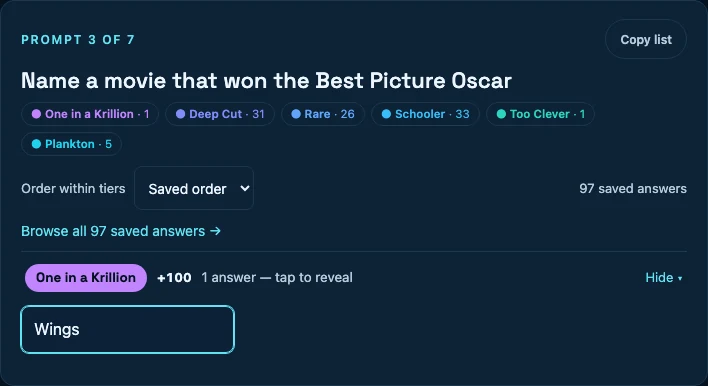
For Wings, check the award rather than merely recognizing an old title. For Ophicleide below, check the instrument’s playing mechanism. The vocabulary guide shows the museum object beside its saved grade.
- Wings: 100 on the July 18 Best Picture question. Titanic was 10; Gladiator and Parasite were 30.
- Ophicleide: 100 on the August 24 brass-instrument question. Its physical construction and playing method help explain why it belongs.
A museum object or award record supplies the qualifying fact for your note. The illustrated answer cases explain these connections in more detail.
Check whether the saved question contains a gem
In our fixed 75-day, 525-prompt study, 14 saved prompts contained no gem entry: 14 ÷ 525 × 100 ≈ 2.67%. The study lists the affected dates and their saved score ceilings.
- Keep the study’s 75-day window with its totals.
- Browse the other tiers for a candidate you can recall.
- Seven Deep Cuts total 7 × 85 = 595 points, or 5,950 metres.
Keep one useful example after playing
Record the date, full question, answer and qualifying fact. Add the grade as a historical result, then use an available practice dive to try the checking routine. Keep one useful connection to revisit.