
A useful Krillion strategy starts with the prompt's boundaries, then a few valid candidates. A dated answer sheet can show how a past candidate was graded; it cannot tell us how many people submitted it or promise the same tier on another question. Here are four practical checks you can make under the timer.
1. Read the condition before naming candidates
- Identify the category and every required qualifier.
- Separate requirements such as “must” from examples introduced by “like.”
- Keep an answer you can explain and spell while you explore another idea.
Check the category, qualifiers and examples in the exact prompt. On August 22's Indian Ocean coastline question, Jordan received 100 points, while Australia and India received 10. That is a dated observation about one prepared answer set. It does not show why the creator chose those tiers or whether a different coastal-country prompt would grade them the same way. The category preparation guide works through actual prompts where conditions and examples lead to different checks.
2. Search the category along one clear axis
After your first idea, try one systematic pass: regions for countries, decades for media, or subtypes for animals and instruments. On August 24's crescent-flag question, Pakistan and Turkey were Plankton while Comoros and Turkmenistan were Deep Cut. A regional sweep could surface a different candidate; it does not guarantee a better tier. The separate first-answer exercise gives a compact way to practice this opening step.
3. Keep a candidate you can justify
The fixed scoring gap is real: Schooler earns 30, Rare 60 and Deep Cut 85; a non-accepted guess earns none of those points. If a more unusual candidate might not satisfy the prompt, a clear category fit is the safer choice. We do not know anyone's hit rate, so there is no universal risk threshold. Use the score calculator and worked examples to compare point outcomes without treating them as player probabilities.
Fix a visible input error first
In this holiday example, Dwhali receives a retry message; correcting it to Diwali earns Schooler, 30 points. Correct an identifiable typo before abandoning a candidate that fits the question. A retry message alone cannot tell you whether every other spelling or category interpretation would work. Use the rejected-answer checks when the cause remains uncertain.
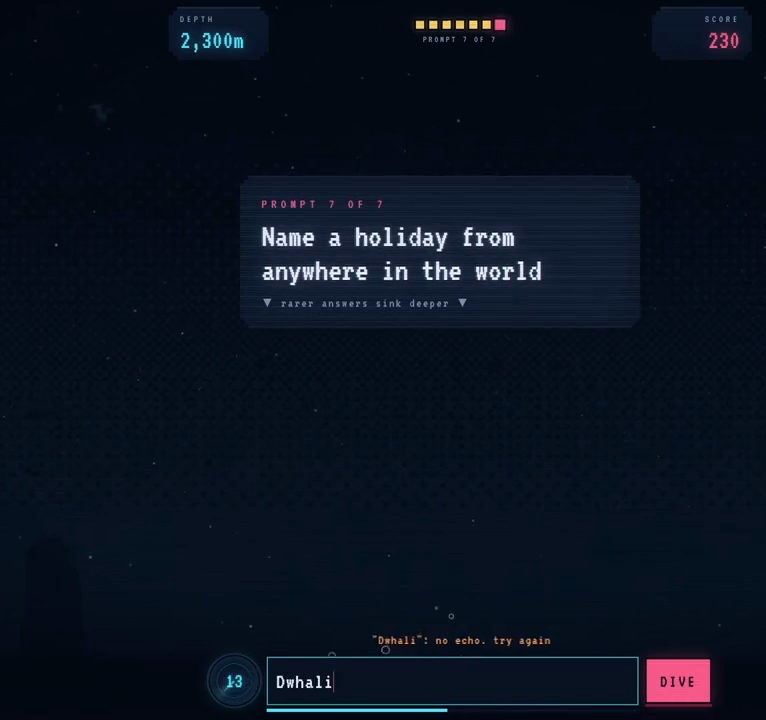
Check the result before deciding what went wrong
| What you see | What it tells you | Next check |
|---|---|---|
| Retry message | The submitted entry has not been accepted yet. | Check the spelling and complete prompt; try a supported fallback. |
| Accepted, 10 points | The answer counted at Plankton. | Review candidate choices after making submissions reliable. |
| No accepted entry shown | You have no accepted result to compare. | Review what reached the input and how much time you left to submit. |
The following two screenshots are from At the Movies, where results use blocks. Keep them separate from Daily Dive results in metres. Jason Voorhees receives 10 points despite a hurried finish; Rango also receives 10 for a western-movie prompt. Judge each entry by its displayed result.


Keep a fallback while assessing an alternative. In a Harrison Ford film example, returning to The Fugitive earns 30 points after a different title receives a retry. Before switching, account for the time needed to recall the exact name, replace the text and submit. Leave a margin suited to your typing speed and the answer's length.
4. Review the exact date, then check what changed
After a dive, compare your candidate with the dated answer sheet. Record the prompt constraint you missed and a different valid example, rather than memorizing a tier as a permanent property of a word. You can search saved answer assignments by word on Answer Lookup or rehearse the candidate choice with untimed historical practice. Neither tool validates an unlisted guess for the official game.
- Record the full prompt and what you actually submitted.
- Note whether the entry was accepted and its displayed tier.
- Choose one thing to practise: prompt reading, spelling, submission timing or another recall branch.
A Daily Dive with scores of 10, 10, 60, 30, 60, 60 and 30 totals 260 points and 2,600 metres. Use the score calculator to total known tiers; it cannot predict the score of a film title or another word you have not submitted. The rarity method and six score bands explain the assignments.
Why this boundary matters: the official FAQ says rarity can use familiarity data or model assistance with a manual pass, depending on the question. It does not describe live player-vote scoring.
Frequently asked questions
What is a good score in Krillion?
There is no published player-score percentile to define a good score. Seven Schooler results total 210 points; three Rare results plus four Schoolers total 300. Use those as arithmetic examples, not a benchmark against other players.
Should I always try the most obscure answer?
No. A guess that is not accepted gets no tier points. Check the prompt's exact scope and use an answer you can defend before reaching for a more speculative one. The saved sheets show past assignments, not the odds of a future guess.
Can past sheets predict today's tier?
No. A saved sheet lets you inspect what received a tier for that question and date. It can give you category ideas, but the official game says its rarity method varies by question, and the public archive does not contain player submission rates.