
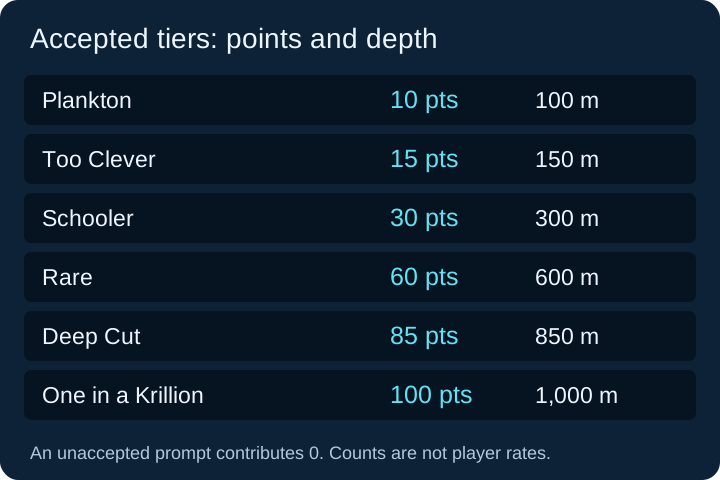
Krillion has six accepted-answer tiers worth 10, 15, 30, 60, 85 and 100 points. A completed prompt without an accepted answer contributes zero. Too Clever at 15 is an accepted grade, not a rejection.
Read points and metres together
| Tier | Points | Metres |
|---|---|---|
| Plankton | 10 | 100 |
| Too Clever | 15 | 150 |
| Schooler | 30 | 300 |
| Rare | 60 | 600 |
| Deep Cut | 85 | 850 |
| One in a Krillion | 100 | 1,000 |
Multiply points by ten for depth. These labels are not published percentage bands such as “only 1% of players.” The official FAQ explains that rarity methods vary by question.
Why an accepted answer can still score low

Read the tier label and +15 together. The themed pack displays distance in blocks; the Daily Dive uses metres. A pack’s visual distance unit should not be copied into a Daily Dive score calculation.
- Correct fit and tier assignment are different questions.
- Too Clever describes a familiar “obscure” choice, not a spelling penalty.
- The gem also considers enjoyment, rather than rarity alone.
- A saved answer count is not a player count.
An answer is not permanently a Deep Cut or a gem. Basque pelota was saved at 100 for July 16’s Summer Olympics question, and 15 for July 29’s racquet-or-paddle question. Keep the question and date beside the grade.
Add a seven-question example
100 + 85 + 60 + 30 + 15 + 10 + 0 = 300 points
300 × 10 = 3,000 metres
This is a demonstration of the scale, not a typical scorecard. Seven Rare answers would give 7 × 60 = 420 points; seven Schooler answers give 7 × 30 = 210. Neither is a measured community average.
Which page helps with your result?
- Know your seven tiers? Use the score calculator.
- Know the word? Use Answer Lookup and inspect its dated context.
- Want to understand the method? Read the rarity explanation.
- Got a retry rather than a tier? Use the rejection checks.
No match in a saved roster is not proof that the official game would reject the input. Do not assign it an official tier from appearance, word length or a similar question.