
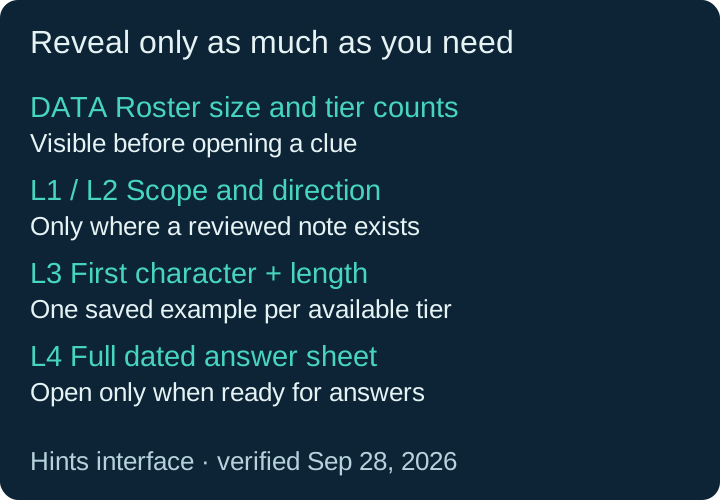
The Hints page gives each of the seven questions a sequence of clues. Start with the wording, follow a recall direction, then open a character or story clue if you need more help. Stop when an answer comes to mind.
First, check the saved date
The heading names the Dive number and date. Match its question wording to the game you are playing. Use the seven question links to jump to the one you need.
What is visible before you reveal anything
Every saved prompt starts with two factual summaries:
- the number of recorded answer entries; and
- the count stored in each displayed rarity tier.
Those counts come from the dated roster. Use the total to gauge the list size and the tier counts to choose which clues to open.
The progressive controls
L1 — Understand the question
L1 explains the requested category and its conditions. For example, a leg-exercise question excludes cardio, while a Fortnite question excludes sidekicks and pets. Read these conditions before choosing a name.
L2 — Get a thinking direction
L2 suggests a way to search your memory. For glove-wearing sports, group the sports by what the glove does: grip, impact protection, handling equipment or fielding a ball. For perfume brands, try countries, eras and specialist perfume houses.
L3 — Reveal a character clue
L3 shows the first Unicode letter or digit and the letter/digit count of one recorded example from each available tier. Spaces and punctuation are excluded. A 100-point example can also include its recorded story note. Notes that spell out the selected answer’s name are omitted from this clue.
L4 — Open the full dated sheet
L4 links directly to that question in the dated answer sheet. The answer groups remain collapsible, letting you inspect one tier at a time.
A worked scope hint: which kind of movie answer?
The October 13 character prompt asks for a fictional character played by more than one actor in live-action movies. Before naming anyone, work through the condition:
- L1: pin down the scope. The response must be a character. A performer or film title answers a different question. A voice role or television appearance alone does not satisfy this live-action movie condition.
- L2: choose a recall route. Think through franchises with recast roles or new versions, then check the live-action film connection. This gives you a direction without naming an answer.
- Stop if a candidate comes to mind. You do not need L3 or the full roster simply because more controls are available.
Finished that historical prompt? Compare three recorded grades
The October 13 sheet records Batman at 10, Captain America at 30 and Lewis Dodgson at 100 points. These are character names, with grades tied to that question and date. Recognition alone does not establish the score.
Open the movie prompt guide for the title-versus-character checks and a short practice exercise.
If your candidate still feels uncertain, ask which part is missing: the role’s name, the second performance, or the film-versus-TV boundary. That identifies what to check after the dive. Check that missing connection before choosing the name.
A worked character clue: Lettish
The September 28 language-ending-in-ish prompt stores Lettish as its only 100-point entry. Its top-tier character clue is L · 7: first letter L, seven characters in total. This example intentionally reveals a past answer so you can understand the control before using it on an unfamiliar prompt.
The count ignores spaces and punctuation, and includes letters and digits. It describes one selected recorded example per tier, not every answer in that tier. Use the clue to narrow your recall, then open L4 to compare complete names.
Choose the smallest useful step
| Your situation | Smallest useful step | What it reveals |
|---|---|---|
| You only want to gauge the roster | Visible DATA | Entry and tier counts |
| The wording is unclear | L1 | Scope explanation |
| You need a direction | L2 | Editorial recall path |
| You have a half-formed candidate | L3 | One example’s first character and length per tier, plus a top-tier story clue |
| The dive is over | L4 | Link to the full dated roster |
Find a different date or a remembered answer
The archive lists previous dives by date and question. To find a word you remember, use Answer Lookup and open its matching dated question. The 100-point answer collection also lets you filter top-scoring entries by keyword and date.
Avoid a timing mistake
The official game gives 25 seconds per prompt. Opening another page during a live round uses some of that time. If you want a no-timer exercise, use Practice mode with an eligible past dive, then review the dated roster afterward.
Where the clues come from
Roster counts, character clues and story notes use the dated sheet. Scope and recall directions explain the question wording; new questions also receive a summary of the roster’s word forms. The methodology explains the archive sources.