
Does Krillion Repeat Prompts? We Compared 75 Saved Dives
Across 75 saved dives, Krillion used 525 prompt slots. After lowercasing the wording and ignoring punctuation differences, 524 prompt wordings were unique. One normalized prompt appeared twice: the chemical-element question ending in “-ium.”
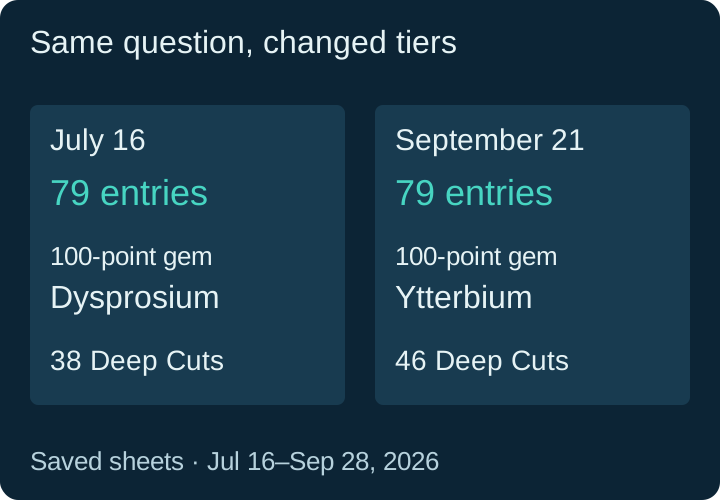
The one repeated wording
- July 16, 2026: “Name a chemical element whose name ends in “-ium””
- September 21, 2026: “Name a chemical element whose name ends in -ium”
The quotation marks changed, but the task did not. You can inspect both original sheets: July 16 and September 21.
| Saved roster detail | July 16 | September 21 |
|---|---|---|
| Total entries | 79 | 79 |
| Deep Cut entries | 38 | 46 |
| Rare entries | 17 | 17 |
| Schooler entries | 13 | 10 |
| Too Clever entries | 2 | 0 |
| Plankton entries | 8 | 5 |
| 100-point entry | Dysprosium | Ytterbium |
The roster stayed the same size, but the tier mix and the selected 100-point entry changed. That is enough to show why an old answer-and-tier pairing should be treated as a dated snapshot, not a promise about a later appearance.
What this means for practice
- Exact-answer memorization has had little opportunity to pay off. One slot beyond the 524 distinct normalized wordings is roughly 0.2% of 525 slots. Two slots belong to the repeated pair; these are different ways of counting recurrence. That describes this saved period only; it does not predict the next dive.
- Category knowledge still transfers. Countries, foods, animals and screen culture recur even when the exact wording does not. The category prep sheet uses dated examples to show those patterns.
- The dated source matters. If a word appears on multiple sheets, compare each prompt separately in the answer checker instead of keeping only its best historical score.
Method and limits
The comparison covers this site’s 75 saved sheets from July 16 through September 28, 2026. Normalization lowercased each prompt and removed punctuation, so the two “-ium” phrasings count as the same wording. It did not merge broader semantic variants such as two different country questions.
The archive is not a complete history before July 16, and a future repeat can change the observed rate. This analysis describes saved prompt text and tiers; it does not reveal how many players submitted an answer.
Reproduce the comparison
In the prompt CSV, filter the prompt column for “ium.” Compare the two complete element-name prompts, not unrelated words that happen to contain those letters. Each row has an archive URL and six tier counts, so you can inspect the original entries. The counts total 79 on each date even though the distribution changes.
What should you study instead?
Use old sheets to train recognition, constraints and rarity judgment. Pick a past date in Practice mode, then check the exact dated roster after the round. That preserves the useful part of repetition—learning the shape of a prompt—without assuming the same word will keep the same tier.