
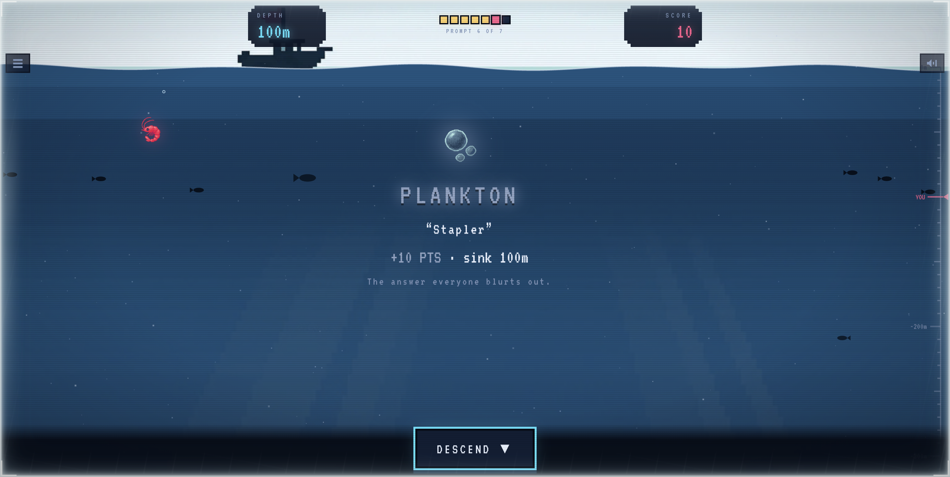
Too Clever in Krillion earns exactly 15 points (150 meters). Seeing a 15-point score appear on your daily dive card can feel frustrating. Your answer was accepted as factually true, yet it scored ten points lower than a completely generic 25-point Common pick. Understanding why this tier exists, how the consensus algorithm flags your input, and how to pivot to genuine 100-point Gems is the key to mastering Krillion.
The Mechanics: Technical Loopholes vs Crowded Obscurities
The official Krillion rules and developer notices classify Too Clever inputs into two very different categories. When your response gets marked with the 15-point badge, you triggered one of these two algorithmic gates:
Case 1: The Technicality Loophole
This happens when you submit an answer that satisfies the literal dictionary definition of a prompt, but violates the natural spirit or conversational expectation of the category.
For instance, when a prompt asks for "An animal that lives on land," and a player types "Human." While biologically accurate, submitting human beings is a textbook technical loophole. The game accepts it to maintain factual integrity, but slaps it with a 15-point ceiling so players cannot game the system with cheeky lateral interpretations.
Case 2: The Crowded Obscurity Trap (Consensus Bias)
This is the far more common scenario that trips up experienced trivia competitors. You encounter a prompt like "Name a flightless bird" or "Name a doubly landlocked country."
The casual solver says Ostrich or Switzerland. The seasoned trivia buff thinks: "Aha! Everyone knows ostriches, but I know about the nocturnal New Zealand parrot, the Kakapo!" or "I know Liechtenstein is doubly landlocked!"
What the solver forgets is that every other trivia enthusiast in the English-speaking world learned that exact same trivia nugget from the same pub quizzes and YouTube videos. When thousands of players all submit Kakapo or Liechtenstein simultaneously, the submission frequency spikes. The game identifies that the answer is being treated as a collective shortcut and reduces its value to 15 points.
Scoring Comparison: Where Too Clever Sits on the Ladder
To understand why Too Clever stings so much, look at the full hierarchy of Krillion's point allocation. The game rewards either effortless safety or genuine obscurity, while penalizing middle-ground cleverness:
Notice that Too Clever earns 10 points less than a Common answer like Ostrich. A player who typed the most obvious animal in existence outscored the trivia player who remembered an endangered species from the Antipodes. That ten-point deficit per question quickly adds up: over a seven-prompt round, two Too Clever traps cost you the difference between an elite 550+ score and an average performance.
For a full mathematical breakdown of how these tiers multiply toward the 700-point maximum, consult our complete Krillion rarity tiers breakdown.
The Psychology of Obscurity: Schelling Points in Game Theory
Why do thousands of unrelated players independently select the exact same "rare" word? In economics and game theory, this phenomenon is known as a Schelling focal point.
When humans are asked to choose an unusual member of a set without communicating with each other, their minds naturally converge on the most prominent example of unusualness.
- If asked for a rare fruit, people do not think of the thousands of wild berries native to sub-Saharan Africa. They think of Durian or Dragonfruit.
- If asked for a remote island nation, people converge on Tuvalu or Nauru.
- If asked for an obscure animal with unusual traits, people think of the Axolotl or the Platypus.
Because these examples have high cultural salience within the "weird trivia" subculture, they fail the mathematical test of rarity. True rarity requires stepping off the beaten path of trivia curiosities entirely.
Official Context: The "Too Clever on Trial" Experiment
The 15-point tier has generated intense debate since Krillion's public launch. On September 7, 2026, the game developers released a public community update titled "Too Clever on Trial," inviting player feedback on whether the tier should be removed, rebalanced to 35 points, or kept as a tactical hazard.
The consensus among top competitive solvers was clear: without the Too Clever penalty, rounds become predictable memory drills where players simply regurgitate the same famous novelty facts every day. The penalty forces solvers to expand their vocabulary and cultivate authentic category depth.
Examples Accompanied by Developer Editorial Notes
In several historical daily sheets, Krillion curators attached specific editorial quips explaining why an answer was designated as Too Clever:
Iran: Name a country that borders Iraq or Iran by land
The October 11, 2026 archive sheet records this answer as Too Clever. Accompanying note: Yes, the two in the question are neighbours.
This note confirms the curator's reasoning: the entry was recognized as technically valid, but classified as an expected clever choice.
Iraq: Name a country that borders Iraq or Iran by land
The October 11, 2026 archive sheet records this answer as Too Clever. Accompanying note: Borrowed straight from the question.
This note confirms the curator's reasoning: the entry was recognized as technically valid, but classified as an expected clever choice.
T-Series: Name a YouTuber with more than 10 million subscribers
The October 4, 2026 archive sheet records this answer as Too Clever. Accompanying note: 2019 was interesting
This note confirms the curator's reasoning: the entry was recognized as technically valid, but classified as an expected clever choice.
The Three Warning Signs of a Too Clever Answer
How do you know you are about to trigger the 15-point penalty before you press submit? In our review of 75 recorded dive sheets, high-frequency Too Clever picks share three identifiable traits:
- The "Did You Know?" Fact Factor: If you first encountered the word in an online trivia round-up, an informational graphic, or a school quiz bonus question, it has entered general trivia consciousness. Solvers who take pride in general knowledge gravitate toward the exact same curiosities.
- Singular National Superlatives: When asked for geographical answers, choosing the absolute extreme (such as La Paz for highest capital or Vatican City for smallest nation) frequently activates the trap. Players assume superlatives are rare, but superlatives are the first facts taught in introductory geography.
- Pop Science Celebrities: In zoological and botanical categories, animals with viral internet presence—such as the Axolotl, Blobfish, or Pangolin—are almost guaranteed to score 15 points. Their distinctiveness makes them memorable, and memorability directly correlates with high submission volume.
Category Walk-Through: Where Players Get Trapped Most Frequently
The Too Clever penalty does not distribute evenly across all question types. Certain categories account for a disproportionate share of the 514 recorded 15-point entries:
| Category Type | Frequent 15-Point Trap | Why It Triggers the Penalty | Safe 100-Point Gem Pivot |
|---|---|---|---|
| Geography (Landlocked Nations) | Liechtenstein | Famous for being doubly landlocked; taught in school geography. | Uzbekistan (also doubly landlocked, far lower recall) |
| Zoology (Flightless Birds) | Kakapo | Famous viral conservation mascot; widely shared in online trivia. | Takahe or Inaccessible Island Rail |
| Chemistry (Heavy Metals / Elements) | Mercury | Famous for being liquid at room temperature; intuitive clever choice. | Bromine (also liquid at room temperature, lower reflex rate) |
| Cinema (Oscar Best Picture) | Parasite | Celebrated as the first non-English winner; high recall among cinephiles. | Wings (1927) or Cavalcade (1933) |
How to Avoid the 15-Point Penalty: The Rule of Secondary Association
Eliminating Too Clever penalties from your daily card requires an active shift in your mental search strategy:
- Acknowledge the First Clever Impulse: When an obscure word flashes into your head within three seconds, recognize that it is a candidate for the trap. If it has appeared in viral internet lists, discard it.
- Execute the Secondary Pivot: Look for a sibling specimen in the same category. For flightless birds, if your brain suggests Kakapo, pivot to the Takahe, Weka, or Cassowary. If your brain suggests Liechtenstein for landlocked countries, pivot to Uzbekistan or Laos.
- Verify Spelling Before Submitting: A safe 50-point Deep Cut is always superior to a misspelling that gets rejected for zero points. Check our tactical guide on how to find 100-point Gem answers for specific word banks.
- Study Historical Rosters: Browse through past answer sheets in our historical dive archive to see which answers consistently avoid the trap.
Search Recorded Too Clever Answers Across 75 Dives
Below is our interactive index of 518 distinct prompt-and-answer pairs recorded across 518 Too Clever entries in 94 saved daily dives (July 16, 2026 through October 17, 2026). Use the live filter below to search for specific words or question themes:
518 recorded examples.
No matching records found. Try a broader search term.
- Iran Too Clever · +15
Name a country that borders Iraq or Iran by land
View October 11, 2026 sheet 1 saved appearance - Iraq Too Clever · +15
Name a country that borders Iraq or Iran by land
View October 11, 2026 sheet 1 saved appearance - T-Series Too Clever · +15
Name a YouTuber with more than 10 million subscribers
View October 4, 2026 sheet 1 saved appearance - Electric chair Too Clever · +15
Name a type of chair
View September 29, 2026 sheet 1 saved appearance - Foosball Too Clever · +15
Name a sport that has a goalkeeper
View September 27, 2026 sheet 1 saved appearance - Stripes Too Clever · +15
Name a pattern or print (for example, stripes)
View September 20, 2026 sheet 1 saved appearance - Tomato Too Clever · +15
Name a fruit with a core
View September 15, 2026 sheet 1 saved appearance - Peanut Too Clever · +15
Name a legume
View September 14, 2026 sheet 1 saved appearance - Cabbage Merchant Too Clever · +15
Name a character from Avatar: The Last Airbender (the original series, not Korra)
View September 13, 2026 sheet 1 saved appearance - Krillion Too Clever · +15
Name a word for a huge number (million or bigger)
View September 12, 2026 sheet 1 saved appearance - Human Too Clever · +15
Name a mammal or reptile that lives in the desert
View September 5, 2026 sheet 1 saved appearance - Human Too Clever · +15
Name a living mammal native to Africa
View September 4, 2026 sheet 1 saved appearance - Berkshire Hathaway Too Clever · +15
Name a company in the S&P 500
View August 30, 2026 sheet 1 saved appearance - Coinbase Too Clever · +15
Name a company in the S&P 500
View August 30, 2026 sheet 1 saved appearance - Palantir Too Clever · +15
Name a company in the S&P 500
View August 30, 2026 sheet 1 saved appearance - Reddit Too Clever · +15
Name a company in the S&P 500
View August 30, 2026 sheet 1 saved appearance - Axolotl Too Clever · +15
Name an animal that has an X in its name
View August 30, 2026 sheet 1 saved appearance - Mulligatawny Too Clever · +15
Name a curry
View August 30, 2026 sheet 1 saved appearance - Grover Kent Too Clever · +15
Name a Sesame Street character
View August 30, 2026 sheet 1 saved appearance - Mr. Johnson Too Clever · +15
Name a Sesame Street character
View August 30, 2026 sheet 1 saved appearance - Beats Too Clever · +15
Name an Apple device
View August 30, 2026 sheet 1 saved appearance - False nine Too Clever · +15
Name a position in soccer
View August 30, 2026 sheet 1 saved appearance - Methuselah Too Clever · +15
Name a Bible character
View August 30, 2026 sheet 1 saved appearance - Avocado Too Clever · +15
Name a fruit
View August 29, 2026 sheet 1 saved appearance - Pumpkin Too Clever · +15
Name a fruit
View August 29, 2026 sheet 1 saved appearance - Tomato Too Clever · +15
Name a fruit
View August 29, 2026 sheet 1 saved appearance - Balsa Too Clever · +15
Name a type of wood
View August 29, 2026 sheet 1 saved appearance - Chocolate Too Clever · +15
Name a fermented food or drink
View August 29, 2026 sheet 1 saved appearance - Italy Too Clever · +15
Name a country that borders more than five other countries
View August 29, 2026 sheet 1 saved appearance - Microsoft Bob Too Clever · +15
Name a Microsoft application
View August 29, 2026 sheet 1 saved appearance - Office Assistant Too Clever · +15
Name a Microsoft application
View August 29, 2026 sheet 1 saved appearance - Martian Manhunter Too Clever · +15
Name a member of the Justice League
View August 29, 2026 sheet 1 saved appearance - Sandpaper Too Clever · +15
Name a type of paper
View August 29, 2026 sheet 1 saved appearance - Hawaii Too Clever · +15
Name a country or territory with the Union Jack on its flag
View August 28, 2026 sheet 1 saved appearance - Kakapo Too Clever · +15
Name a living bird that cannot fly
View August 28, 2026 sheet 1 saved appearance - Fondue Too Clever · +15
Name a dip
View August 28, 2026 sheet 1 saved appearance - Hodor Too Clever · +15
Name a Game of Thrones character
View August 28, 2026 sheet 1 saved appearance - Sicko Mode Too Clever · +15
Name a Drake song
View August 28, 2026 sheet 1 saved appearance - Anne Frank House Too Clever · +15
Name a famous museum
View August 28, 2026 sheet 1 saved appearance - Banana Too Clever · +15
Name a berry
View August 27, 2026 sheet 1 saved appearance - Tomato Too Clever · +15
Name a berry
View August 27, 2026 sheet 1 saved appearance - Watermelon Too Clever · +15
Name a berry
View August 27, 2026 sheet 1 saved appearance - Concorde Too Clever · +15
Name an airline
View August 27, 2026 sheet 1 saved appearance - Pan Am Too Clever · +15
Name an airline
View August 27, 2026 sheet 1 saved appearance - Voodoo Doughnut Too Clever · +15
Name a doughnut chain
View August 27, 2026 sheet 1 saved appearance - Latin Too Clever · +15
Name a language written in the Latin alphabet
View August 27, 2026 sheet 1 saved appearance - Arch Linux Too Clever · +15
Name a computer operating system
View August 27, 2026 sheet 1 saved appearance - Human Too Clever · +15
Name an animal that lives in groups
View August 27, 2026 sheet 1 saved appearance - Solomon Grundy Too Clever · +15
Name a nursery rhyme
View August 27, 2026 sheet 1 saved appearance - Ethiopia Too Clever · +15
Name a country where Christianity is the majority religion
View August 26, 2026 sheet 1 saved appearance - Vatican City Too Clever · +15
Name a country where Christianity is the majority religion
View August 26, 2026 sheet 1 saved appearance - Neanderthal Too Clever · +15
Name a prehistoric mammal
View August 26, 2026 sheet 1 saved appearance - Toblerone Too Clever · +15
Name a candy
View August 26, 2026 sheet 1 saved appearance - Turkish delight Too Clever · +15
Name a candy
View August 26, 2026 sheet 1 saved appearance - Fallacy fallacy Too Clever · +15
Name a logical fallacy
View August 26, 2026 sheet 1 saved appearance - Bidet Too Clever · +15
Name something found in a bathroom
View August 26, 2026 sheet 1 saved appearance - Rubber duck Too Clever · +15
Name something found in a bathroom
View August 26, 2026 sheet 1 saved appearance - Yao Ming Too Clever · +15
Name an NBA player in the Hall of Fame
View August 26, 2026 sheet 1 saved appearance - Boxing Day Too Clever · +15
Name a holiday from anywhere in the world
View August 26, 2026 sheet 1 saved appearance - Chad Too Clever · +15
Name a country whose name starts with C
View August 25, 2026 sheet 1 saved appearance - Gnu Too Clever · +15
Name an animal that has a G in its name
View August 25, 2026 sheet 1 saved appearance - Pangolin Too Clever · +15
Name an animal that has a G in its name
View August 25, 2026 sheet 1 saved appearance - Injera Too Clever · +15
Name a pancake or flatbread from any cuisine
View August 25, 2026 sheet 1 saved appearance - Dark Too Clever · +15
Name a Netflix original series
View August 25, 2026 sheet 1 saved appearance - Ed Wood Too Clever · +15
Name a Hollywood director
View August 25, 2026 sheet 1 saved appearance - Tommy Wiseau Too Clever · +15
Name a Hollywood director
View August 25, 2026 sheet 1 saved appearance - Bangladesh Too Clever · +15
Name a country with more than 100 million people
View August 25, 2026 sheet 1 saved appearance - Basket weaving Too Clever · +15
Name a craft or handicraft — a hobby where you make things by hand
View August 25, 2026 sheet 1 saved appearance - Nepal Too Clever · +15
Name a country with a crescent on its flag
View August 24, 2026 sheet 1 saved appearance - Golden ratio Too Clever · +15
Name a math symbol
View August 24, 2026 sheet 1 saved appearance - Imaginary unit Too Clever · +15
Name a math symbol
View August 24, 2026 sheet 1 saved appearance - Takoyaki Too Clever · +15
Name a street food from anywhere in the world
View August 24, 2026 sheet 1 saved appearance - Gabe Lewis Too Clever · +15
Name a character from The Office (US)
View August 24, 2026 sheet 1 saved appearance - Musical.ly Too Clever · +15
Name a platform where you can scroll short-form videos
View August 24, 2026 sheet 1 saved appearance - Vine Too Clever · +15
Name a platform where you can scroll short-form videos
View August 24, 2026 sheet 1 saved appearance - Gorilla Too Clever · +15
Name an animal that is a herbivore
View August 24, 2026 sheet 1 saved appearance - Triceratops Too Clever · +15
Name an animal that is a herbivore
View August 24, 2026 sheet 1 saved appearance - Flugelhorn Too Clever · +15
Name a brass instrument
View August 24, 2026 sheet 1 saved appearance - Saxophone Too Clever · +15
Name a brass instrument
View August 24, 2026 sheet 1 saved appearance - Fiji Water Too Clever · +15
Name a bottled water brand
View August 23, 2026 sheet 1 saved appearance - Liquid Death Too Clever · +15
Name a bottled water brand
View August 23, 2026 sheet 1 saved appearance - Voss Too Clever · +15
Name a bottled water brand
View August 23, 2026 sheet 1 saved appearance - United Kingdom Too Clever · +15
Name a country that was once part of the British Empire
View August 23, 2026 sheet 1 saved appearance - Fix Dessert Chocolatier Too Clever · +15
Name a chocolate brand
View August 23, 2026 sheet 1 saved appearance - Tony's Chocolonely Too Clever · +15
Name a chocolate brand
View August 23, 2026 sheet 1 saved appearance - Bloodborne Too Clever · +15
Name a PlayStation-exclusive franchise
View August 23, 2026 sheet 1 saved appearance - Waterfall chart Too Clever · +15
Name a type of graph or chart
View August 23, 2026 sheet 1 saved appearance - Word cloud Too Clever · +15
Name a type of graph or chart
View August 23, 2026 sheet 1 saved appearance - Hoop Dreams Too Clever · +15
Name a sports movie
View August 23, 2026 sheet 1 saved appearance - Raging Bull Too Clever · +15
Name a sports movie
View August 23, 2026 sheet 1 saved appearance - Steins;Gate Too Clever · +15
Name a top-25 anime (by MyAnimeList popularity)
View August 23, 2026 sheet 1 saved appearance - France Too Clever · +15
Name a country with a coastline on the Indian Ocean
View August 22, 2026 sheet 1 saved appearance - Maldives Too Clever · +15
Name a country with a coastline on the Indian Ocean
View August 22, 2026 sheet 1 saved appearance - Seychelles Too Clever · +15
Name a country with a coastline on the Indian Ocean
View August 22, 2026 sheet 1 saved appearance - Capybara Too Clever · +15
Name an animal that lives in the jungle
View August 22, 2026 sheet 1 saved appearance - Cosmic Crisp Too Clever · +15
Name an apple variety
View August 22, 2026 sheet 1 saved appearance - Marcel Too Clever · +15
Name a Friends character
View August 22, 2026 sheet 1 saved appearance - Paolo Too Clever · +15
Name a Friends character
View August 22, 2026 sheet 1 saved appearance - Beyoncé Too Clever · +15
Name a country music artist
View August 22, 2026 sheet 1 saved appearance - Lil Nas X Too Clever · +15
Name a country music artist
View August 22, 2026 sheet 1 saved appearance - Taylor Swift Too Clever · +15
Name a country music artist
View August 22, 2026 sheet 1 saved appearance - Conan O'Brien Too Clever · +15
Name an actor who has starred in a 2026 movie that grossed over $100 million worldwide
View August 22, 2026 sheet 1 saved appearance - Ellipsis Too Clever · +15
Name a punctuation mark or typographic symbol
View August 22, 2026 sheet 1 saved appearance - Oxford comma Too Clever · +15
Name a punctuation mark or typographic symbol
View August 22, 2026 sheet 1 saved appearance - Pilcrow Too Clever · +15
Name a punctuation mark or typographic symbol
View August 22, 2026 sheet 1 saved appearance - Semicolon Too Clever · +15
Name a punctuation mark or typographic symbol
View August 22, 2026 sheet 1 saved appearance - Sannakji Too Clever · +15
Name a Korean dish
View August 21, 2026 sheet 1 saved appearance - Caspian Sea Too Clever · +15
Name a lake
View August 21, 2026 sheet 1 saved appearance - Lake Baikal Too Clever · +15
Name a lake
View August 21, 2026 sheet 1 saved appearance - Interstellar Too Clever · +15
Name a movie Matt Damon appears in
View August 21, 2026 sheet 1 saved appearance - Bill the Pony Too Clever · +15
Name a Lord of the Rings character
View August 21, 2026 sheet 1 saved appearance - Glorfindel Too Clever · +15
Name a Lord of the Rings character
View August 21, 2026 sheet 1 saved appearance - Tom Bombadil Too Clever · +15
Name a Lord of the Rings character
View August 21, 2026 sheet 1 saved appearance - Michael Myers Too Clever · +15
Name a famous person named Michael
View August 21, 2026 sheet 1 saved appearance - Michael Scott Too Clever · +15
Name a famous person named Michael
View August 21, 2026 sheet 1 saved appearance - Michelangelo Too Clever · +15
Name a famous person named Michael
View August 21, 2026 sheet 1 saved appearance - Pachinko Too Clever · +15
Name a casino game
View August 21, 2026 sheet 1 saved appearance - Sestina Too Clever · +15
Name a type of poem
View August 21, 2026 sheet 1 saved appearance - Villanelle Too Clever · +15
Name a type of poem
View August 21, 2026 sheet 1 saved appearance - Traffic light Too Clever · +15
Name a road or traffic sign
View August 20, 2026 sheet 1 saved appearance - Fly agaric Too Clever · +15
Name a type of mushroom
View August 20, 2026 sheet 1 saved appearance - Hollandaise Too Clever · +15
Name a sauce
View August 20, 2026 sheet 1 saved appearance - Sriracha Too Clever · +15
Name a sauce
View August 20, 2026 sheet 1 saved appearance - Bay of Fundy Too Clever · +15
Name a gulf or bay
View August 20, 2026 sheet 1 saved appearance - Bay of Pigs Too Clever · +15
Name a gulf or bay
View August 20, 2026 sheet 1 saved appearance - Zero-point energy Too Clever · +15
Name a type of energy
View August 20, 2026 sheet 1 saved appearance - Blackburn Rovers Too Clever · +15
Name a Premier League club
View August 20, 2026 sheet 1 saved appearance - Wimbledon Too Clever · +15
Name a Premier League club
View August 20, 2026 sheet 1 saved appearance - Bindle Too Clever · +15
Name a type of bag
View August 20, 2026 sheet 1 saved appearance - Fanny pack Too Clever · +15
Name a type of bag
View August 20, 2026 sheet 1 saved appearance - Macedonia Too Clever · +15
Name a country whose name starts with M
View August 19, 2026 sheet 1 saved appearance - Monaco Too Clever · +15
Name a country whose name starts with M
View August 19, 2026 sheet 1 saved appearance - Krill Too Clever · +15
Name a mollusk or shellfish
View August 19, 2026 sheet 1 saved appearance - Nautilus Too Clever · +15
Name a mollusk or shellfish
View August 19, 2026 sheet 1 saved appearance - Nudibranch Too Clever · +15
Name a mollusk or shellfish
View August 19, 2026 sheet 1 saved appearance - Bienenstich Too Clever · +15
Name a German dish
View August 19, 2026 sheet 1 saved appearance - Doner kebab Too Clever · +15
Name a German dish
View August 19, 2026 sheet 1 saved appearance - T-Series Too Clever · +15
Name a YouTuber with more than 100 million subscribers
View August 19, 2026 sheet 1 saved appearance - Graviton Too Clever · +15
Name a subatomic particle
View August 19, 2026 sheet 1 saved appearance - Higgs boson Too Clever · +15
Name a subatomic particle
View August 19, 2026 sheet 1 saved appearance - Kazakhstan Too Clever · +15
Name a country that has a Z in its name
View August 19, 2026 sheet 1 saved appearance - Brogues Too Clever · +15
Name a type of shoe
View August 19, 2026 sheet 1 saved appearance - Derby Too Clever · +15
Name a type of shoe
View August 19, 2026 sheet 1 saved appearance - Liechtenstein Too Clever · +15
Name a country that starts with the letter L
View August 18, 2026 sheet 1 saved appearance - Djerba Too Clever · +15
Name an island in the Mediterranean
View August 18, 2026 sheet 1 saved appearance - Elba Too Clever · +15
Name an island in the Mediterranean
View August 18, 2026 sheet 1 saved appearance - Dormouse Too Clever · +15
Name an animal that hibernates
View August 18, 2026 sheet 1 saved appearance - Cao lau Too Clever · +15
Name a Thai or Vietnamese dish
View August 18, 2026 sheet 1 saved appearance - Khao soi Too Clever · +15
Name a Thai or Vietnamese dish
View August 18, 2026 sheet 1 saved appearance - Bing Bong Too Clever · +15
Name a Pixar character
View August 18, 2026 sheet 1 saved appearance - Randall Boggs Too Clever · +15
Name a Pixar character
View August 18, 2026 sheet 1 saved appearance - Pluto Too Clever · +15
Name a planet or dwarf planet in our solar system
View August 18, 2026 sheet 1 saved appearance - Fauxhawk Too Clever · +15
Name a hairstyle
View August 18, 2026 sheet 1 saved appearance - Mullet Too Clever · +15
Name a hairstyle
View August 18, 2026 sheet 1 saved appearance - Magdalena Too Clever · +15
Name a river in the Americas
View August 17, 2026 sheet 1 saved appearance - Pav bhaji Too Clever · +15
Name an Indian dish
View August 17, 2026 sheet 1 saved appearance - Vada Too Clever · +15
Name an Indian dish
View August 17, 2026 sheet 1 saved appearance - Bosko Too Clever · +15
Name a Looney Tunes character
View August 17, 2026 sheet 1 saved appearance - Gossamer Too Clever · +15
Name a Looney Tunes character
View August 17, 2026 sheet 1 saved appearance - Bauxite Too Clever · +15
Name a rock or mineral
View August 17, 2026 sheet 1 saved appearance - Galena Too Clever · +15
Name a rock or mineral
View August 17, 2026 sheet 1 saved appearance - Gambeson Too Clever · +15
Name a piece of armor
View August 17, 2026 sheet 1 saved appearance - Sabaton Too Clever · +15
Name a piece of armor
View August 17, 2026 sheet 1 saved appearance - Gaffer tape Too Clever · +15
Name a type of tape
View August 17, 2026 sheet 1 saved appearance - Red tape Too Clever · +15
Name a type of tape
View August 17, 2026 sheet 1 saved appearance - Tape measure Too Clever · +15
Name a type of tape
View August 17, 2026 sheet 1 saved appearance - Sargasso Sea Too Clever · +15
Name a sea
View August 16, 2026 sheet 1 saved appearance - Sea of Tranquility Too Clever · +15
Name a sea
View August 16, 2026 sheet 1 saved appearance - Bird-of-paradise Too Clever · +15
Name a songbird
View August 16, 2026 sheet 1 saved appearance - Bulbul Too Clever · +15
Name a songbird
View August 16, 2026 sheet 1 saved appearance - Wagtail Too Clever · +15
Name a songbird
View August 16, 2026 sheet 1 saved appearance - Dan dan noodles Too Clever · +15
Name a Chinese dish
View August 16, 2026 sheet 1 saved appearance - Xiaolongbao Too Clever · +15
Name a Chinese dish
View August 16, 2026 sheet 1 saved appearance - Khan Too Clever · +15
Name a Star Trek character
View August 16, 2026 sheet 1 saved appearance - Q Too Clever · +15
Name a Star Trek character
View August 16, 2026 sheet 1 saved appearance - Geriatrics Too Clever · +15
Name a medical specialty
View August 16, 2026 sheet 1 saved appearance - Otolaryngology Too Clever · +15
Name a medical specialty
View August 16, 2026 sheet 1 saved appearance - Comic Sans Too Clever · +15
Name a font
View August 16, 2026 sheet 1 saved appearance - Papyrus Too Clever · +15
Name a font
View August 16, 2026 sheet 1 saved appearance - Wingdings Too Clever · +15
Name a font
View August 16, 2026 sheet 1 saved appearance - Bosnia and Herzegovina Too Clever · +15
Name a country whose name starts with B
View August 15, 2026 sheet 1 saved appearance - Quokka Too Clever · +15
Name a marsupial
View August 15, 2026 sheet 1 saved appearance - Cacio e pepe Too Clever · +15
Name an Italian dish
View August 15, 2026 sheet 1 saved appearance - Chicken parmesan Too Clever · +15
Name an Italian dish
View August 15, 2026 sheet 1 saved appearance - Michio Kaku Too Clever · +15
Name a famous physicist
View August 15, 2026 sheet 1 saved appearance - Neil deGrasse Tyson Too Clever · +15
Name a famous physicist
View August 15, 2026 sheet 1 saved appearance - Oakland Athletics Too Clever · +15
Name a current or former MLB team
View August 15, 2026 sheet 1 saved appearance - Gabardine Too Clever · +15
Name a fabric or textile
View August 15, 2026 sheet 1 saved appearance - Tulle Too Clever · +15
Name a fabric or textile
View August 15, 2026 sheet 1 saved appearance - Alligator snapping turtle Too Clever · +15
Name a type of turtle or tortoise
View August 14, 2026 sheet 1 saved appearance - Kemp's ridley Too Clever · +15
Name a type of turtle or tortoise
View August 14, 2026 sheet 1 saved appearance - Jarritos Too Clever · +15
Name a soda brand
View August 14, 2026 sheet 1 saved appearance - San Pellegrino Too Clever · +15
Name a soda brand
View August 14, 2026 sheet 1 saved appearance - Jeni's Too Clever · +15
Name an ice cream brand
View August 14, 2026 sheet 1 saved appearance - Van Leeuwen Too Clever · +15
Name an ice cream brand
View August 14, 2026 sheet 1 saved appearance - Anthropocene Too Clever · +15
Name a geologic eon, era, period, or epoch
View August 14, 2026 sheet 1 saved appearance - Carboniferous Too Clever · +15
Name a geologic eon, era, period, or epoch
View August 14, 2026 sheet 1 saved appearance - British Bulldog Too Clever · +15
Name a playground game
View August 14, 2026 sheet 1 saved appearance - Kick the can Too Clever · +15
Name a playground game
View August 14, 2026 sheet 1 saved appearance - Forint Too Clever · +15
Name a current national or shared currency
View August 14, 2026 sheet 1 saved appearance - Zloty Too Clever · +15
Name a current national or shared currency
View August 14, 2026 sheet 1 saved appearance - United Kingdom Too Clever · +15
Name a country that has a G in its name
View August 13, 2026 sheet 1 saved appearance - Chaise longue Too Clever · +15
Name a piece of furniture
View August 13, 2026 sheet 1 saved appearance - Ibrahim Traoré Too Clever · +15
Name a current world leader (head of state or government)
View August 13, 2026 sheet 1 saved appearance - Leprechaun Too Clever · +15
Name a horror movie franchise
View August 13, 2026 sheet 1 saved appearance - Puppet Master Too Clever · +15
Name a horror movie franchise
View August 13, 2026 sheet 1 saved appearance - Zimbabwe Too Clever · +15
Name a country that uses the dollar
View August 13, 2026 sheet 1 saved appearance - Free solo climbing Too Clever · +15
Name an extreme sport
View August 13, 2026 sheet 1 saved appearance - Parkour Too Clever · +15
Name an extreme sport
View August 13, 2026 sheet 1 saved appearance - Drive Too Clever · +15
Name a Ryan Gosling movie
View August 13, 2026 sheet 1 saved appearance - Cantonese Too Clever · +15
Name a language with more than 50 million total speakers
View August 12, 2026 sheet 1 saved appearance - Javanese Too Clever · +15
Name a language with more than 50 million total speakers
View August 12, 2026 sheet 1 saved appearance - Aardvark Too Clever · +15
Name a nocturnal animal
View August 12, 2026 sheet 1 saved appearance - Tarsier Too Clever · +15
Name a nocturnal animal
View August 12, 2026 sheet 1 saved appearance - Congee Too Clever · +15
Name a breakfast food or drink
View August 12, 2026 sheet 1 saved appearance - Shakshuka Too Clever · +15
Name a breakfast food or drink
View August 12, 2026 sheet 1 saved appearance - Squirrel Girl Too Clever · +15
Name a member of the Avengers
View August 12, 2026 sheet 1 saved appearance - Herpetology Too Clever · +15
Name a branch of science ending in -ology
View August 12, 2026 sheet 1 saved appearance - Bahá'í Faith Too Clever · +15
Name a religion with more than one million followers
View August 12, 2026 sheet 1 saved appearance - Andorra Too Clever · +15
Name a country whose name ends in the letter A
View August 12, 2026 sheet 1 saved appearance - Denmark Too Clever · +15
Name a sovereign country whose flag contains both red and white
View August 11, 2026 sheet 1 saved appearance - Nepal Too Clever · +15
Name a sovereign country whose flag contains both red and white
View August 11, 2026 sheet 1 saved appearance - Axolotl Too Clever · +15
Name an animal threatened with extinction
View August 11, 2026 sheet 1 saved appearance - Pangolin Too Clever · +15
Name an animal threatened with extinction
View August 11, 2026 sheet 1 saved appearance - Hanger steak Too Clever · +15
Name a cut of beef
View August 11, 2026 sheet 1 saved appearance - The Andrews Sisters Too Clever · +15
Name a girl group
View August 11, 2026 sheet 1 saved appearance - Wilson Phillips Too Clever · +15
Name a girl group
View August 11, 2026 sheet 1 saved appearance - Neil deGrasse Tyson Too Clever · +15
Name a famous scientist
View August 11, 2026 sheet 1 saved appearance - Rosalind Franklin Too Clever · +15
Name a famous scientist
View August 11, 2026 sheet 1 saved appearance - Burgertime Too Clever · +15
Name an arcade game
View August 11, 2026 sheet 1 saved appearance - Pong Too Clever · +15
Name an arcade game
View August 11, 2026 sheet 1 saved appearance - Bosnia and Herzegovina Too Clever · +15
Name a team that played in the 2026 FIFA World Cup
View August 11, 2026 sheet 1 saved appearance - North Korea Too Clever · +15
Name a country that shares a land or maritime border with Russia
View August 10, 2026 sheet 1 saved appearance - Poland Too Clever · +15
Name a country that shares a land or maritime border with Russia
View August 10, 2026 sheet 1 saved appearance - Alpaca Too Clever · +15
Name a farm animal
View August 10, 2026 sheet 1 saved appearance - Bibimbap Too Clever · +15
Name a rice dish
View August 10, 2026 sheet 1 saved appearance - Congee Too Clever · +15
Name a rice dish
View August 10, 2026 sheet 1 saved appearance - Dick Cavett Too Clever · +15
Name a talk show host
View August 10, 2026 sheet 1 saved appearance - Jerry Springer Too Clever · +15
Name a talk show host
View August 10, 2026 sheet 1 saved appearance - Mosaic Too Clever · +15
Name a web browser
View August 10, 2026 sheet 1 saved appearance - Netscape Too Clever · +15
Name a web browser
View August 10, 2026 sheet 1 saved appearance - Tor Too Clever · +15
Name a web browser
View August 10, 2026 sheet 1 saved appearance - Point Break Too Clever · +15
Name a movie James Cameron directed, wrote, or produced
View August 10, 2026 sheet 1 saved appearance - Jakarta Too Clever · +15
Name a world capital city south of the equator
View August 9, 2026 sheet 1 saved appearance - Nairobi Too Clever · +15
Name a world capital city south of the equator
View August 9, 2026 sheet 1 saved appearance - Quito Too Clever · +15
Name a world capital city south of the equator
View August 9, 2026 sheet 1 saved appearance - Basilisk Too Clever · +15
Name a lizard species
View August 9, 2026 sheet 1 saved appearance - Gila monster Too Clever · +15
Name a lizard species
View August 9, 2026 sheet 1 saved appearance - Beignet Too Clever · +15
Name a type of pastry or doughnut
View August 9, 2026 sheet 1 saved appearance - Cronut Too Clever · +15
Name a type of pastry or doughnut
View August 9, 2026 sheet 1 saved appearance - The Suburbs Too Clever · +15
Name a Grammy Album of the Year winner
View August 9, 2026 sheet 1 saved appearance - Dopamine Too Clever · +15
Name a human hormone
View August 9, 2026 sheet 1 saved appearance - Oxytocin Too Clever · +15
Name a human hormone
View August 9, 2026 sheet 1 saved appearance - Biathlon Too Clever · +15
Name a sport or discipline ever contested or demonstrated at the Winter Olympics
View August 9, 2026 sheet 1 saved appearance - Curling Too Clever · +15
Name a sport or discipline ever contested or demonstrated at the Winter Olympics
View August 9, 2026 sheet 1 saved appearance - Skeleton Too Clever · +15
Name a sport or discipline ever contested or demonstrated at the Winter Olympics
View August 9, 2026 sheet 1 saved appearance - Pegasus 3 Too Clever · +15
Name a 2026 movie that had grossed at least $200 million worldwide by August 8
View August 9, 2026 sheet 1 saved appearance - Burma Too Clever · +15
Name a country that no longer exists
View August 8, 2026 sheet 1 saved appearance - Roman Empire Too Clever · +15
Name a country that no longer exists
View August 8, 2026 sheet 1 saved appearance - Friesian Too Clever · +15
Name a horse breed
View August 8, 2026 sheet 1 saved appearance - Lipizzaner Too Clever · +15
Name a horse breed
View August 8, 2026 sheet 1 saved appearance - Okonomiyaki Too Clever · +15
Name a Japanese dish
View August 8, 2026 sheet 1 saved appearance - Onigiri Too Clever · +15
Name a Japanese dish
View August 8, 2026 sheet 1 saved appearance - Lord Farquaad Too Clever · +15
Name a Shrek character
View August 8, 2026 sheet 1 saved appearance - Vostok Too Clever · +15
Name a space mission or program
View August 8, 2026 sheet 1 saved appearance - Bobby Jones Too Clever · +15
Name a golfer who has won a major championship
View August 8, 2026 sheet 1 saved appearance - Greg Norman Too Clever · +15
Name a golfer who has won a major championship
View August 8, 2026 sheet 1 saved appearance - Boy Too Clever · +15
Name a Roald Dahl book
View August 8, 2026 sheet 1 saved appearance - Dominica Too Clever · +15
Name a Caribbean island
View August 7, 2026 sheet 1 saved appearance - Bombardier beetle Too Clever · +15
Name a beetle
View August 7, 2026 sheet 1 saved appearance - Scarab Too Clever · +15
Name a beetle
View August 7, 2026 sheet 1 saved appearance - Caprese Too Clever · +15
Name a type of salad
View August 7, 2026 sheet 1 saved appearance - Panzanella Too Clever · +15
Name a type of salad
View August 7, 2026 sheet 1 saved appearance - Bill Murray Too Clever · +15
Name a Saturday Night Live cast member
View August 7, 2026 sheet 1 saved appearance - Julia Louis-Dreyfus Too Clever · +15
Name a Saturday Night Live cast member
View August 7, 2026 sheet 1 saved appearance - Norm Macdonald Too Clever · +15
Name a Saturday Night Live cast member
View August 7, 2026 sheet 1 saved appearance - Biotin Too Clever · +15
Name a vitamin or dietary mineral
View August 7, 2026 sheet 1 saved appearance - Molybdenum Too Clever · +15
Name a vitamin or dietary mineral
View August 7, 2026 sheet 1 saved appearance - The Snow Queen Too Clever · +15
Name a fairy tale
View August 7, 2026 sheet 1 saved appearance - Abidjan Too Clever · +15
Name an African capital city
View August 6, 2026 sheet 1 saved appearance - Cotonou Too Clever · +15
Name an African capital city
View August 6, 2026 sheet 1 saved appearance - Ouagadougou Too Clever · +15
Name an African capital city
View August 6, 2026 sheet 1 saved appearance - Black swan Too Clever · +15
Name a type of waterfowl
View August 6, 2026 sheet 1 saved appearance - Mandarin duck Too Clever · +15
Name a type of waterfowl
View August 6, 2026 sheet 1 saved appearance - Birria Too Clever · +15
Name a Mexican dish
View August 6, 2026 sheet 1 saved appearance - Elote Too Clever · +15
Name a Mexican dish
View August 6, 2026 sheet 1 saved appearance - Mole Too Clever · +15
Name a Mexican dish
View August 6, 2026 sheet 1 saved appearance - Bruce Too Clever · +15
Name a Disney villain
View August 6, 2026 sheet 1 saved appearance - Chernabog Too Clever · +15
Name a Disney villain
View August 6, 2026 sheet 1 saved appearance - Torus Too Clever · +15
Name a geometric shape
View August 6, 2026 sheet 1 saved appearance - Qatar Too Clever · +15
Name a country that has hosted the FIFA World Cup
View August 6, 2026 sheet 1 saved appearance - Dr. Seuss Too Clever · +15
Name a famous poet
View August 6, 2026 sheet 1 saved appearance - Homer Too Clever · +15
Name a famous poet
View August 6, 2026 sheet 1 saved appearance - Rumi Too Clever · +15
Name a famous poet
View August 6, 2026 sheet 1 saved appearance - Scotland Too Clever · +15
Name a country whose name starts with S
View August 5, 2026 sheet 1 saved appearance - Swaziland Too Clever · +15
Name a country whose name starts with S
View August 5, 2026 sheet 1 saved appearance - Coconut crab Too Clever · +15
Name a crab or other crustacean
View August 5, 2026 sheet 1 saved appearance - Horseshoe crab Too Clever · +15
Name a crab or other crustacean
View August 5, 2026 sheet 1 saved appearance - Confit Too Clever · +15
Name a cooking method
View August 5, 2026 sheet 1 saved appearance - Sous vide Too Clever · +15
Name a cooking method
View August 5, 2026 sheet 1 saved appearance - Troy McClure Too Clever · +15
Name a Simpsons character
View August 5, 2026 sheet 1 saved appearance - Plasma Too Clever · +15
Name a state of matter
View August 5, 2026 sheet 1 saved appearance - Long snapper Too Clever · +15
Name a position in American football
View August 5, 2026 sheet 1 saved appearance - Nickelback Too Clever · +15
Name a position in American football
View August 5, 2026 sheet 1 saved appearance - 1941 Too Clever · +15
Name a Steven Spielberg movie
View August 5, 2026 sheet 1 saved appearance - The Lost World: Jurassic Park Too Clever · +15
Name a Steven Spielberg movie
View August 5, 2026 sheet 1 saved appearance - Bahrain Too Clever · +15
Name a country in the Middle East
View August 4, 2026 sheet 1 saved appearance - Kakapo Too Clever · +15
Name a parrot species
View August 4, 2026 sheet 1 saved appearance - Kea Too Clever · +15
Name a parrot species
View August 4, 2026 sheet 1 saved appearance - Chimichurri Too Clever · +15
Name a condiment
View August 4, 2026 sheet 1 saved appearance - Gochujang Too Clever · +15
Name a condiment
View August 4, 2026 sheet 1 saved appearance - Hush Too Clever · +15
Name a Batman villain
View August 4, 2026 sheet 1 saved appearance - The Court of Owls Too Clever · +15
Name a Batman villain
View August 4, 2026 sheet 1 saved appearance - Blind spot Too Clever · +15
Name a part of the human eye
View August 4, 2026 sheet 1 saved appearance - Fovea Too Clever · +15
Name a part of the human eye
View August 4, 2026 sheet 1 saved appearance - James Hunt Too Clever · +15
Name a Formula 1 world champion
View August 4, 2026 sheet 1 saved appearance - The Long Walk Too Clever · +15
Name a Stephen King novel
View August 4, 2026 sheet 1 saved appearance - Thinner Too Clever · +15
Name a Stephen King novel
View August 4, 2026 sheet 1 saved appearance - Delaware Too Clever · +15
Name a US state
View August 3, 2026 sheet 1 saved appearance - Rhode Island Too Clever · +15
Name a US state
View August 3, 2026 sheet 1 saved appearance - Arapaima Too Clever · +15
Name a freshwater fish
View August 3, 2026 sheet 1 saved appearance - Piranha Too Clever · +15
Name a freshwater fish
View August 3, 2026 sheet 1 saved appearance - Khinkali Too Clever · +15
Name a type of dumpling
View August 3, 2026 sheet 1 saved appearance - Manti Too Clever · +15
Name a type of dumpling
View August 3, 2026 sheet 1 saved appearance - EarthBound Too Clever · +15
Name a Nintendo video game franchise
View August 3, 2026 sheet 1 saved appearance - F-Zero Too Clever · +15
Name a Nintendo video game franchise
View August 3, 2026 sheet 1 saved appearance - Derecho Too Clever · +15
Name a weather phenomenon
View August 3, 2026 sheet 1 saved appearance - Polar vortex Too Clever · +15
Name a weather phenomenon
View August 3, 2026 sheet 1 saved appearance - Jack Johnson Too Clever · +15
Name a heavyweight boxing world champion
View August 3, 2026 sheet 1 saved appearance - And to Think That I Saw It on Mulberry Street Too Clever · +15
Name a Dr. Seuss book
View August 3, 2026 sheet 1 saved appearance - Australia Too Clever · +15
Name a country with a monarchy
View August 2, 2026 sheet 1 saved appearance - Canada Too Clever · +15
Name a country with a monarchy
View August 2, 2026 sheet 1 saved appearance - Honey badger Too Clever · +15
Name an animal whose name starts with H
View August 2, 2026 sheet 1 saved appearance - Human Too Clever · +15
Name an animal whose name starts with H
View August 2, 2026 sheet 1 saved appearance - Shoofly pie Too Clever · +15
Name a type of pie
View August 2, 2026 sheet 1 saved appearance - Whoopie pie Too Clever · +15
Name a type of pie
View August 2, 2026 sheet 1 saved appearance - Avengers: Doomsday Too Clever · +15
Name a Marvel Cinematic Universe movie
View August 2, 2026 sheet 1 saved appearance - Avengers: Secret Wars Too Clever · +15
Name a Marvel Cinematic Universe movie
View August 2, 2026 sheet 1 saved appearance - The Incredible Hulk Too Clever · +15
Name a Marvel Cinematic Universe movie
View August 2, 2026 sheet 1 saved appearance - The Marvels Too Clever · +15
Name a Marvel Cinematic Universe movie
View August 2, 2026 sheet 1 saved appearance - Baobab Too Clever · +15
Name a species of tree
View August 2, 2026 sheet 1 saved appearance - Ginkgo Too Clever · +15
Name a species of tree
View August 2, 2026 sheet 1 saved appearance - Goran Ivanisevic Too Clever · +15
Name a tennis player who has won a Grand Slam singles title
View August 2, 2026 sheet 1 saved appearance - Michael Chang Too Clever · +15
Name a tennis player who has won a Grand Slam singles title
View August 2, 2026 sheet 1 saved appearance - Stan Smith Too Clever · +15
Name a tennis player who has won a Grand Slam singles title
View August 2, 2026 sheet 1 saved appearance - Dogs Playing Poker Too Clever · +15
Name a famous painting
View August 2, 2026 sheet 1 saved appearance - Impression, Sunrise Too Clever · +15
Name a famous painting
View August 2, 2026 sheet 1 saved appearance - The Son of Man Too Clever · +15
Name a famous painting
View August 2, 2026 sheet 1 saved appearance - Vitruvian Man Too Clever · +15
Name a famous painting
View August 2, 2026 sheet 1 saved appearance - Luxembourg Too Clever · +15
Name a country in the European Union
View August 1, 2026 sheet 1 saved appearance - Elf owl Too Clever · +15
Name an owl species
View August 1, 2026 sheet 1 saved appearance - Basque cheesecake Too Clever · +15
Name a type of cake
View August 1, 2026 sheet 1 saved appearance - Opera cake Too Clever · +15
Name a type of cake
View August 1, 2026 sheet 1 saved appearance - Antz Too Clever · +15
Name a DreamWorks Animation movie
View August 1, 2026 sheet 1 saved appearance - Bee Movie Too Clever · +15
Name a DreamWorks Animation movie
View August 1, 2026 sheet 1 saved appearance - Damascus steel Too Clever · +15
Name a metal alloy
View August 1, 2026 sheet 1 saved appearance - Electrum Too Clever · +15
Name a metal alloy
View August 1, 2026 sheet 1 saved appearance - Tungsten carbide Too Clever · +15
Name a metal alloy
View August 1, 2026 sheet 1 saved appearance - Aston Villa Too Clever · +15
Name a soccer club that has won the European Cup or Champions League
View August 1, 2026 sheet 1 saved appearance - Nottingham Forest Too Clever · +15
Name a soccer club that has won the European Cup or Champions League
View August 1, 2026 sheet 1 saved appearance - Holst Too Clever · +15
Name a famous classical composer
View August 1, 2026 sheet 1 saved appearance - Pachelbel Too Clever · +15
Name a famous classical composer
View August 1, 2026 sheet 1 saved appearance - Bosphorus Too Clever · +15
Name a strait (a narrow sea passage between two landmasses)
View July 31, 2026 sheet 1 saved appearance - Angler fish Too Clever · +15
Name a creature that lives in the deep sea
View July 31, 2026 sheet 1 saved appearance - Carolina Reaper Too Clever · +15
Name a variety of chili pepper
View July 31, 2026 sheet 1 saved appearance - Ghost pepper Too Clever · +15
Name a variety of chili pepper
View July 31, 2026 sheet 1 saved appearance - Mewtwo Too Clever · +15
Name a Pokémon from the original 151
View July 31, 2026 sheet 1 saved appearance - Hippopotomonstrosesquippedaliophobia Too Clever · +15
Name a phobia (its formal name, like 'arachnophobia')
View July 31, 2026 sheet 1 saved appearance - Triskaidekaphobia Too Clever · +15
Name a phobia (its formal name, like 'arachnophobia')
View July 31, 2026 sheet 1 saved appearance - Paul Morphy Too Clever · +15
Name a world chess champion
View July 31, 2026 sheet 1 saved appearance - Ever Given Too Clever · +15
Name a famous ship (real or fictional)
View July 31, 2026 sheet 1 saved appearance - Theseus's ship Too Clever · +15
Name a famous ship (real or fictional)
View July 31, 2026 sheet 1 saved appearance - Liberia Too Clever · +15
Name a country whose flag uses all three of red, white, and blue, and no other colors
View July 30, 2026 sheet 1 saved appearance - Capybara Too Clever · +15
Name a rodent
View July 30, 2026 sheet 1 saved appearance - Lapsang Souchong Too Clever · +15
Name a type of tea
View July 30, 2026 sheet 1 saved appearance - Natasha, Pierre & The Great Comet of 1812 Too Clever · +15
Name a Broadway musical
View July 30, 2026 sheet 1 saved appearance - Ronna Too Clever · +15
Name a metric (SI) prefix
View July 30, 2026 sheet 1 saved appearance - Gordian knot Too Clever · +15
Name a type of knot
View July 30, 2026 sheet 1 saved appearance - Atlantis Too Clever · +15
Name an ancient civilization
View July 30, 2026 sheet 1 saved appearance - Jerusalem Too Clever · +15
Name the capital city of an Asian country
View July 29, 2026 sheet 1 saved appearance - Goliath birdeater Too Clever · +15
Name a species of spider
View July 29, 2026 sheet 1 saved appearance - Elvis sandwich Too Clever · +15
Name a type of sandwich
View July 29, 2026 sheet 1 saved appearance - Hot dog Too Clever · +15
Name a type of sandwich
View July 29, 2026 sheet 1 saved appearance - Ice cream sandwich Too Clever · +15
Name a type of sandwich
View July 29, 2026 sheet 1 saved appearance - Zurg Too Clever · +15
Name a Toy Story character
View July 29, 2026 sheet 1 saved appearance - Bloop Too Clever · +15
Name a cryptid (a creature like Bigfoot whose existence is claimed but unproven)
View July 29, 2026 sheet 1 saved appearance - Basque pelota Too Clever · +15
Name a sport played with a racquet or paddle
View July 29, 2026 sheet 1 saved appearance - Canoeing Too Clever · +15
Name a sport played with a racquet or paddle
View July 29, 2026 sheet 1 saved appearance - Kayaking Too Clever · +15
Name a sport played with a racquet or paddle
View July 29, 2026 sheet 1 saved appearance - Arcimboldo Too Clever · +15
Name a Renaissance artist
View July 29, 2026 sheet 1 saved appearance - Hieronymus Bosch Too Clever · +15
Name a Renaissance artist
View July 29, 2026 sheet 1 saved appearance - Axolotl Too Clever · +15
Name an amphibian
View July 28, 2026 sheet 1 saved appearance - Matcha Too Clever · +15
Name an ice cream flavor
View July 28, 2026 sheet 1 saved appearance - Darth Plagueis Too Clever · +15
Name a Star Wars character
View July 28, 2026 sheet 1 saved appearance - Jar Jar Binks Too Clever · +15
Name a Star Wars character
View July 28, 2026 sheet 1 saved appearance - Murder Too Clever · +15
Name a collective noun for a group of animals (like 'murder' for crows)
View July 28, 2026 sheet 1 saved appearance - Bulgarian split squat Too Clever · +15
Name a gym exercise
View July 28, 2026 sheet 1 saved appearance - Croque monsieur Too Clever · +15
Name a classic French dish
View July 28, 2026 sheet 1 saved appearance - Equatorial Guinea Too Clever · +15
Name a country where Spanish is an official language
View July 27, 2026 sheet 1 saved appearance - Australopithecus Too Clever · +15
Name a primate species
View July 27, 2026 sheet 1 saved appearance - Aye-aye Too Clever · +15
Name a primate species
View July 27, 2026 sheet 1 saved appearance - Human Too Clever · +15
Name a primate species
View July 27, 2026 sheet 1 saved appearance - Neanderthal Too Clever · +15
Name a primate species
View July 27, 2026 sheet 1 saved appearance - Zagnut Too Clever · +15
Name a candy bar
View July 27, 2026 sheet 1 saved appearance - Brockhampton Too Clever · +15
Name a boy band
View July 27, 2026 sheet 1 saved appearance - Mesentery Too Clever · +15
Name an organ of the human body
View July 27, 2026 sheet 1 saved appearance - Skin Too Clever · +15
Name an organ of the human body
View July 27, 2026 sheet 1 saved appearance - Crow pose Too Clever · +15
Name a yoga pose
View July 27, 2026 sheet 1 saved appearance - Hot Springs Too Clever · +15
Name a US national park
View July 27, 2026 sheet 1 saved appearance - Karakoram Too Clever · +15
Name a mountain range
View July 26, 2026 sheet 1 saved appearance - Stick insect Too Clever · +15
Name an insect
View July 26, 2026 sheet 1 saved appearance - Bouillabaisse Too Clever · +15
Name a soup
View July 26, 2026 sheet 1 saved appearance - Joe Versus the Volcano Too Clever · +15
Name a movie starring Tom Hanks
View July 26, 2026 sheet 1 saved appearance - Ultramarine Too Clever · +15
Name a shade of blue
View July 26, 2026 sheet 1 saved appearance - YInMn blue Too Clever · +15
Name a shade of blue
View July 26, 2026 sheet 1 saved appearance - Mandoline Too Clever · +15
Name a kitchen utensil
View July 26, 2026 sheet 1 saved appearance - Tyr Too Clever · +15
Name a Norse god or goddess
View July 26, 2026 sheet 1 saved appearance - Kyrgyzstan Too Clever · +15
Name a former republic of the Soviet Union
View July 25, 2026 sheet 1 saved appearance - Archaeopteryx Too Clever · +15
Name a dinosaur
View July 25, 2026 sheet 1 saved appearance - Compsognathus Too Clever · +15
Name a dinosaur
View July 25, 2026 sheet 1 saved appearance - Megalodon Too Clever · +15
Name a dinosaur
View July 25, 2026 sheet 1 saved appearance - Pineapple Too Clever · +15
Name a pizza topping
View July 25, 2026 sheet 1 saved appearance - Get Smart Too Clever · +15
Name a TV sitcom
View July 25, 2026 sheet 1 saved appearance - Happy Days Too Clever · +15
Name a TV sitcom
View July 25, 2026 sheet 1 saved appearance - Brainfuck Too Clever · +15
Name a programming language
View July 25, 2026 sheet 1 saved appearance - Whitespace Too Clever · +15
Name a programming language
View July 25, 2026 sheet 1 saved appearance - 20km race walk Too Clever · +15
Name an Olympic track and field event
View July 25, 2026 sheet 1 saved appearance - Kola nut Too Clever · +15
Name a nut
View July 25, 2026 sheet 1 saved appearance - Antarctic Desert Too Clever · +15
Name a desert
View July 24, 2026 sheet 1 saved appearance - Boomslang Too Clever · +15
Name a snake species
View July 24, 2026 sheet 1 saved appearance - Titanoboa Too Clever · +15
Name a snake species
View July 24, 2026 sheet 1 saved appearance - Bulletproof coffee Too Clever · +15
Name a coffee drink
View July 24, 2026 sheet 1 saved appearance - Dalgona coffee Too Clever · +15
Name a coffee drink
View July 24, 2026 sheet 1 saved appearance - Ouya Too Clever · +15
Name a video game console
View July 24, 2026 sheet 1 saved appearance - Virtual Boy Too Clever · +15
Name a video game console
View July 24, 2026 sheet 1 saved appearance - Sartorius Too Clever · +15
Name a muscle in the human body
View July 24, 2026 sheet 1 saved appearance - Tongue Too Clever · +15
Name a muscle in the human body
View July 24, 2026 sheet 1 saved appearance - Ushanka Too Clever · +15
Name a style of hat
View July 24, 2026 sheet 1 saved appearance - Titus Andronicus Too Clever · +15
Name a Shakespeare play
View July 24, 2026 sheet 1 saved appearance - Monaco Too Clever · +15
Name a country with a Mediterranean coastline
View July 23, 2026 sheet 1 saved appearance - Narwhal Too Clever · +15
Name a whale species
View July 23, 2026 sheet 1 saved appearance - Durian Too Clever · +15
Name a tropical fruit
View July 23, 2026 sheet 1 saved appearance - Scrappy-Doo Too Clever · +15
Name a Scooby-Doo character
View July 23, 2026 sheet 1 saved appearance - Lenticular Too Clever · +15
Name a type of cloud
View July 23, 2026 sheet 1 saved appearance - Mammatus Too Clever · +15
Name a type of cloud
View July 23, 2026 sheet 1 saved appearance - Lindy hop Too Clever · +15
Name a style of dance
View July 23, 2026 sheet 1 saved appearance - Voguing Too Clever · +15
Name a style of dance
View July 23, 2026 sheet 1 saved appearance - Commodus Too Clever · +15
Name a Roman emperor
View July 23, 2026 sheet 1 saved appearance - Elagabalus Too Clever · +15
Name a Roman emperor
View July 23, 2026 sheet 1 saved appearance - Rubicon Too Clever · +15
Name a river in Europe
View July 22, 2026 sheet 1 saved appearance - Macaroni penguin Too Clever · +15
Name a penguin species
View July 22, 2026 sheet 1 saved appearance - Weetabix Too Clever · +15
Name a breakfast cereal brand
View July 22, 2026 sheet 1 saved appearance - Never Say Never Again Too Clever · +15
Name a James Bond film
View July 22, 2026 sheet 1 saved appearance - Moldavite Too Clever · +15
Name a gemstone
View July 22, 2026 sheet 1 saved appearance - Obsidian Too Clever · +15
Name a gemstone
View July 22, 2026 sheet 1 saved appearance - Carcassonne Too Clever · +15
Name a board game
View July 22, 2026 sheet 1 saved appearance - Basque Too Clever · +15
Name a language spoken in Europe
View July 22, 2026 sheet 1 saved appearance - Latin Too Clever · +15
Name a language spoken in Europe
View July 22, 2026 sheet 1 saved appearance - Liechtenstein Too Clever · +15
Name a landlocked country
View July 21, 2026 sheet 1 saved appearance - Luxembourg Too Clever · +15
Name a landlocked country
View July 21, 2026 sheet 1 saved appearance - Megalodon Too Clever · +15
Name a shark species
View July 21, 2026 sheet 1 saved appearance - Boulevardier Too Clever · +15
Name a cocktail
View July 21, 2026 sheet 1 saved appearance - Negroni Sbagliato Too Clever · +15
Name a cocktail
View July 21, 2026 sheet 1 saved appearance - Peeves Too Clever · +15
Name a Harry Potter character
View July 21, 2026 sheet 1 saved appearance - Europa Too Clever · +15
Name a moon of a planet in our solar system
View July 21, 2026 sheet 1 saved appearance - Ninjutsu Too Clever · +15
Name a martial art
View July 21, 2026 sheet 1 saved appearance - Manticore Too Clever · +15
Name a mythical creature
View July 21, 2026 sheet 1 saved appearance - Mothman Too Clever · +15
Name a mythical creature
View July 21, 2026 sheet 1 saved appearance - Kazakhstan Too Clever · +15
Name a country in Asia
View July 20, 2026 sheet 1 saved appearance - Platypus Too Clever · +15
Name a venomous or poisonous animal
View July 20, 2026 sheet 1 saved appearance - Saffron Too Clever · +15
Name an herb or spice
View July 20, 2026 sheet 1 saved appearance - Treasure Planet Too Clever · +15
Name a Walt Disney Animation Studios feature film
View July 20, 2026 sheet 1 saved appearance - Furlong Too Clever · +15
Name a unit of measurement
View July 20, 2026 sheet 1 saved appearance - St. Louis Too Clever · +15
Name a city that has hosted the Summer or Winter Olympics
View July 20, 2026 sheet 1 saved appearance - Corpse flower Too Clever · +15
Name a type of flower
View July 20, 2026 sheet 1 saved appearance - Nauru Too Clever · +15
Name an island country
View July 19, 2026 sheet 1 saved appearance - Pallas's cat Too Clever · +15
Name a species of wild cat
View July 19, 2026 sheet 1 saved appearance - Pumpernickel Too Clever · +15
Name a type of bread
View July 19, 2026 sheet 1 saved appearance - Grave of the Fireflies Too Clever · +15
Name a Studio Ghibli film
View July 19, 2026 sheet 1 saved appearance - Coccyx Too Clever · +15
Name a bone in the human body
View July 19, 2026 sheet 1 saved appearance - Egyptian Ratscrew Too Clever · +15
Name a card game
View July 19, 2026 sheet 1 saved appearance - Millard Fillmore Too Clever · +15
Name a US president
View July 19, 2026 sheet 1 saved appearance - William Henry Harrison Too Clever · +15
Name a US president
View July 19, 2026 sheet 1 saved appearance - Ankara Too Clever · +15
Name the capital city of a European country
View July 18, 2026 sheet 1 saved appearance - Bern Too Clever · +15
Name the capital city of a European country
View July 18, 2026 sheet 1 saved appearance - Kumquat Too Clever · +15
Name a citrus fruit
View July 18, 2026 sheet 1 saved appearance - Yuzu Too Clever · +15
Name a citrus fruit
View July 18, 2026 sheet 1 saved appearance - Shakespeare in Love Too Clever · +15
Name a movie that won the Best Picture Oscar
View July 18, 2026 sheet 1 saved appearance - Big Dipper Too Clever · +15
Name an officially recognized constellation
View July 18, 2026 sheet 1 saved appearance - Pleiades Too Clever · +15
Name an officially recognized constellation
View July 18, 2026 sheet 1 saved appearance - Seattle SuperSonics Too Clever · +15
Name an NBA team
View July 18, 2026 sheet 1 saved appearance - Rutabaga Too Clever · +15
Name a root vegetable
View July 18, 2026 sheet 1 saved appearance - Nike Too Clever · +15
Name a Greek god or goddess
View July 18, 2026 sheet 1 saved appearance - Suriname Too Clever · +15
Name a country in the Americas (North, Central, or South)
View July 17, 2026 sheet 1 saved appearance - Harpy eagle Too Clever · +15
Name a bird of prey
View July 17, 2026 sheet 1 saved appearance - Secretary bird Too Clever · +15
Name a bird of prey
View July 17, 2026 sheet 1 saved appearance - Casu martzu Too Clever · +15
Name a type of cheese
View July 17, 2026 sheet 1 saved appearance - Limburger Too Clever · +15
Name a type of cheese
View July 17, 2026 sheet 1 saved appearance - Revolution 9 Too Clever · +15
Name a Beatles song
View July 17, 2026 sheet 1 saved appearance - Omicron Too Clever · +15
Name a letter of the Greek alphabet
View July 17, 2026 sheet 1 saved appearance - Pierre Too Clever · +15
Name a US state capital
View July 17, 2026 sheet 1 saved appearance - Basenji Too Clever · +15
Name a dog breed
View July 17, 2026 sheet 1 saved appearance - Corgi Too Clever · +15
Name a dog breed
View July 17, 2026 sheet 1 saved appearance - Kakapo Too Clever · +15
Name an animal whose name starts with K
View July 16, 2026 sheet 1 saved appearance - Krill Too Clever · +15
Name an animal whose name starts with K
View July 16, 2026 sheet 1 saved appearance - Chad Too Clever · +15
Name a country in Africa
View July 16, 2026 sheet 1 saved appearance - Djibouti Too Clever · +15
Name a country in Africa
View July 16, 2026 sheet 1 saved appearance - Bucatini Too Clever · +15
Name a pasta shape
View July 16, 2026 sheet 1 saved appearance - Couscous Too Clever · +15
Name a pasta shape
View July 16, 2026 sheet 1 saved appearance - Orecchiette Too Clever · +15
Name a pasta shape
View July 16, 2026 sheet 1 saved appearance - The Good Dinosaur Too Clever · +15
Name a Pixar feature film
View July 16, 2026 sheet 1 saved appearance - Francium Too Clever · +15
Name a chemical element whose name ends in "-ium"
View July 16, 2026 sheet 1 saved appearance - Gallium Too Clever · +15
Name a chemical element whose name ends in "-ium"
View July 16, 2026 sheet 1 saved appearance - Breaking Too Clever · +15
Name a sport that has ever been part of the Summer Olympics
View July 16, 2026 sheet 1 saved appearance - Race walking Too Clever · +15
Name a sport that has ever been part of the Summer Olympics
View July 16, 2026 sheet 1 saved appearance - Trampoline Too Clever · +15
Name a sport that has ever been part of the Summer Olympics
View July 16, 2026 sheet 1 saved appearance - Cowbell Too Clever · +15
Name an instrument found in a symphony orchestra
View July 16, 2026 sheet 1 saved appearance - Triangle Too Clever · +15
Name an instrument found in a symphony orchestra
View July 16, 2026 sheet 1 saved appearance
Frequently asked questions
What does Too Clever mean in Krillion?
Too Clever is an accepted answer tier worth 15 points in Krillion's scoring system. It captures two distinct submission scenarios: technical loophole qualifications that stretch category intent, and well-known 'obscure' trivia answers that many players submit at the same time.
Why did my answer get 15 points instead of 100?
When multiple trivia-minded players simultaneously reach for the same popular 'obscurity' (such as Kakapo for flightless bird or Liechtenstein for landlocked country), its popularity index spikes into the Too Clever tier, capping its value at 15 points.
Does receiving Too Clever mean my answer was incorrect?
No. A Too Clever answer is 100% valid, factually true, and accepted by the official answer roster. However, because it falls into a consensus trap or semantic loophole, the game awards 15 points rather than a higher rarity payout.
Is Too Clever worse than a Common answer?
In points, yes. A Common answer awards 25 points, while a Too Clever answer awards only 15 points. It is designed to penalize predictable 'gotcha' guesses that fail to show true category depth.
How can I avoid getting Too Clever in future daily rounds?
Apply the 'One Step Deeper' rule: discard your immediate clever trivia thought and pick a secondary specimen from the same category that lacks internet meme status or pub quiz fame.